Chapter 9
Americanism on Trial:
HUAC, the Hollywood Ten, and the Politics of Anti-Communism
In the depression, which our most conservative economists agree is coming, the soil for demagoguery grows rich and fertile. . . . In this [climate], the liberal and progressive, the union man, the people, and anyone who subscribes to full democratic practice are liquidated. Today we see coming true what was said by one of the worst Americans, Huey Long: Fascism will come to America in the guise of Americanism.—Adrian Scott, notes for "You Can't Do That"
1In the summer of 1947, following the critical and popular success of Crossfire, thirty-six-year-old Adrian Scott was at the peak of his Hollywood career. Though his creative prospects had never been brighter, Scott's mood, as he and other Hollywood progressives contemplated the postwar political scene, was increasingly bleak. In 1947, ominous portents, mirroring the dislocations that had fueled European fascism after World War One, were everywhere: fears of rising inflation and a return of the depression, concerns about the reintegration of war veterans, rising anti-Semitism and racism, and a flurry of antilabor legislation all suggested to them that America was on the road to fascism. Sweeping Republican victories in the 1946 elections, giving conservatives a majority in Congress, fueled significant challenges to the New Deal order—the defeat of the Economic Bill of Rights and passage of the antilabor Taft-Hartley Act, in particular—and exacerbated the emerging Cold War with the Soviet Union. Progressives placed the blame for the rising conservative tide squarely on President Truman, citing a laundry list of political failures: his belligerent mishandling of Stalin at Potsdam; his institutionalization of a hard-line containment policy toward the Soviets in the Truman Doctrine and the Marshall Plan; his requirement of anti-Communist loyalty oaths for federal employees; his replacement of prominent and effective New Dealers with cronies from his own political machine; his bungling of the postwar economic reconversion; his willingness to use state power against the labor movement during the postwar strike wave, and so on.1
2By 1947, it had become abundantly clear that Harry S. Truman was no Franklin Delano Roosevelt. Therefore Scott, like many Hollywood leftists, supported the Progressive Party and Henry A. Wallace in the 1948 presidential election. Wallace, former vice president and a New Dealer par excellence, seemed, far more than Truman, a worthy heir to Roosevelt's legacy. With his vision of a "Century of the Common Man," Wallace revitalized the hopes of the Popular Front. Historian Norman D. Markowitz has commented:
Advocating a new international order in which the injustices that had created depression, Fascism, and war would be eliminated, Wallace became the leading wartime defender of what Freda Kirchway, the publisher of the Nation, called a 'New Deal for the world.' . . . [Wallace and] the social liberals believed that the planning and social welfare of the New Deal, institutionalized by a United Nations organization and made workable by Soviet-American cooperation, could merge with the revolutionary aspirations of oppressed peoples abroad to create a just and lasting peace. The creation of a world New Deal would in turn help to reinvigorate the New Deal at home.2
Wallace's third-party candidacy, however, was a sign of the growing rift between radicals and liberals. Though his calls to extend the New Deal at home appealed to many liberals, Wallace's insistence that domestic security and economic abundance depended on friendly relations with the Soviet Union proved divisive. Indeed, the issue of domestic anti-Communism and postwar policy toward the Soviet Union became the line in the sand that definitively split the Popular Front.
3Postwar changes in the Communist Party line significantly exacerbated these tensions. The ouster of "revisionist" Party leader Earl Browder in 1945 marked a return to the more militant, revolutionary stance of the early 1930s. The new Party head, William Z. Foster, revived the CPUSA, which in May 1944 had been dissolved by Browder and replaced with the Communist Political Association; he denounced the Popular Front and "Browderism," arguing, "Comrade Browder denies the class struggle by sowing illusions among the workers of a long postwar period of harmonious class relations with generous-minded employers. . . . Browder's line is a rejection of the Marxian concept of the progressive and revolutionary initiative of the working class and with it, the vanguard role of the Communist Party."3 The "independent" stance of the postwar Party, repudiating Truman and the Democrats and endorsing the pro-Soviet policies of the Progressive Party, alienated its liberal allies and undermined the coalition politics of the Popular Front. By 1947, these simmering tensions fueled a decisive split, as Communists and Wallaceite liberals banded together to form the Progressive Citizens of America (PCA), while anti-Communist liberals created the Americans for Democratic Action (ADA). In Hollywood, the liberal-radical split first played itself out on the terrain of union politics, as a series of violent strikes by the militant and democratic Conference of Studio Unions (CSU) in 1945 and 1946, part of the massive postwar strike wave, seriously divided the progressive film community.4
4Against this backdrop of a conservative offensive against Communism and a deepening schism between liberals and radicals, the House Un-American Activities Committee turned its attention once more to Hollywood. The twin threats of Jewish domination and Communist infiltration of Hollywood had long preoccupied American conservatives, and the film industry had weathered innumerable attacks by both federal and state investigating committees since the mid-1930s. In 1947, however, the political landscape had considerably altered, and Hollywood was more vulnerable than ever before to charges of un-Americanism. Most importantly, the war years had fueled a new recognition of the power of the screen to shape public opinion. In a nation only too aware of the Nazi uses of mass culture to win the hearts and minds of ordinary Germans, the charges of Communist influence in Hollywood provoked alarm and dismay on both the Right and Left, though for very different reasons. During the war years, "freedom of the screen" was touted as one of the fundamental differences between democracy and fascism; thus, in the contest between HUAC and Hollywood, each side proclaimed the other "un-American." For the conservatives, the evidence of Red propaganda in Hollywood films proved that an international conspiracy of Jews and Communists was undermining American cultural values and democratic traditions. For the Hollywood radicals, the HUAC investigation was a harbinger of fascism in America, the opening salvo in a far-reaching reactionary plan to undermine basic American freedoms and the progress toward social democracy begun by the New Deal.
The Conservative Offensive
5The postwar leaders of the House Un-American Activities Committee were Mississippi Democrat John E. Rankin and New Jersey Republican J. Parnell Thomas. Well known for their anti-internationalist, anti-New Deal voting records, both subscribed to an anti-Communism that hearkened back to the xenophobic, antimodernist "100 Percent Americanism" of the 1920s. Thomas, who became chair of HUAC in January 1947, had been active on the Committee since its beginnings in the mid-1930s. Long suspicious of the New Deal cultural agenda, he was among the first to call for an investigation of the Federal Theater Project, denouncing it as "a hotbed for Communists" and "one more link in the vast and unparalleled New Deal propaganda machine." In the postwar period, Thomas focused his bile more particularly on the Communist Party, "bombarding" the Attorney General's office with letters "urging him to prosecute the CP for failing to register as a foreign agent and for seeking the violent overthrow of the government," and writing to Truman, "The immunity which this foreign-directed conspiracy has been enjoying for the past fifteen years must cease."
6
Rankin, who had held his heavily poll-taxed congressional seat for over two decades, shared Thomas's anti-Communism but was particularly notorious for his white supremacist views. Frequently proclaiming his desire to "save America for white gentile Americans," he considered the Klan an eminently "American institution" and counted among his supporters such native fascists as Gerald L. K. Smith, Father Charles Coughlin, Gerald P. Winrod, and William Dudley Pelley. The more sordid aspects of his political career were detailed in Introducing . . . Congressman John Elliott Rankin, a pamphlet produced by the Hollywood Popular Front group HICCASP. Pointing out Rankin's consistent support for the racist poll tax, the HICCASP pamphlet noted snidely: "He has established the record of representing the smallest number of actual voters in proportion to the population of the district represented. Related document:
Introducing John Rankin (PDF)He has also established the record of getting himself elected the most times with the least number of voters." Rankin was also notorious for his anti-Semitic comments on the floor of the House, particularly his characterization of columnist Walter Winchell as "the communistic little kike." In another widely reported comment, Rankin vilified a group of women who met with him in 1943 to protest his stand against overseas soldiers' voting in the 1944 presidential election: "If I am any judge, they are communists, pure and simple; probably more simple than pure. They looked like foreigners to me. I never saw such a wilderness of noses in my life."5
7On July 17, 1945, on the floor of the House, Rankin had denounced the Jewish-Communist conspiracy in Hollywood, proclaiming that "alien-minded communistic enemies of Christianity are trying to take over the motion picture industry and spread their un-American propaganda as well as their loathsome, lying, immoral and anti-Christian filth before the eyes of your children in every community in America." HICCASP accused Rankin, a master of publicity, of targeting the film industry to compensate for bad press following his attempts to block an investigation into conditions in veterans' hospitals.6 Certainly, as the earlier investigations by Dies, Tenney, and others had amply demonstrated, publicity was one of the great enticements of an investigation of Hollywood. In 1947, unlike in earlier investigations, HUAC could count on considerable support from within the film industry, and indeed, had been "invited" to come to Hollywood by the Motion Picture Alliance for the Preservation of American Ideals.
8Founded in February 1944 by a coalition of right-wing Hollywood activists, including actors Robert Taylor, Adolphe Menjou, and Gary Cooper, studio boss Walt Disney, labor leader Roy Brewer, and others, and led by director Sam Wood, the Alliance worked to combat public perceptions of radical influence in Hollywood: " In our special field of motion pictures, we resent the growing impression that this industry is made up of, and dominated by, Communists, radicals and crack-pots. . . . We pledge to fight, with every means at our organized command, any effort of any group or individual, to divert the loyalty of the screen from the free America that gave it birth." Indeed, the public announcement of the Alliance's founding was timed to highlight the Red infiltration of Hollywood: the following night the internationalist Hollywood Free World Association hosted a fundraising dinner where a glittering array of liberal Hollywood stars—Olivia de Havilland, Walter Wanger, Walter Huston, and many others—gathered to hear the featured speaker, then-Vice President Henry Wallace, an outspoken supporter of greater cooperation with the Soviet Union.7
9From its inception, the Alliance shrewdly sought support from conservative and patriotic organizations outside the film industry, including the Republican Party, the Knights of Columbus, the American Legion, the Tenney Committee, and, of course, HUAC.8 The Alliance members shared with HUAC two key preoccupations: Communist infiltration of the Hollywood unions, and radical influence on film content. The antilabor thrust of the Alliance was evident from the beginning, and many of the leading members were well known for their "anti-strike, pro-management, pro-industrial harmony positions." Several founders of the Alliance, for example, had been active in the Screen Playwrights, the company union founded to challenge the Screen Writers Guild in the 1930s, while Alliance officer Roy Brewer was the head of the conservative craft guild International Alliance of Theatrical Stage Employees (IATSE), another company union with a long history of Red-baiting, strike-breaking, and general thuggery. According to Brewer, the postwar strikes by the CSU demonstrated that "[t]here has been a real Communist plot to capture our unions in Hollywood, as part of the Communist plan to control the motion-picture industry."9
10Similarly, the Alliance believed that the Screen Writers Guild was "lousy with Reds" who used the screen to disseminate un-American ideas and values. Their greatest outrage was directed at the pro-Soviet films produced during the war with the encouragement of the Office of War Information (OWI)—Song of Russia, Mission to Moscow, The North Star—but they also saw evidence of Communist influence in a wide variety of progressive films, including Crossfire, The Farmer's Daughter, and The Best Years of Our Lives. Novelist Ayn Rand articulated the Alliance's version of loyal American film content in Screen Guide for Americans, a 1950 pamphlet that offered such guidelines as "Don't Smear the Free Enterprise System," "Don't Deify the 'Common Man,'" and "Don't Smear Industrialists." The pamphlet was widely distributed by the Alliance and reprinted in a number of leading newspapers, including the front page of the entertainment section of the New York Times. That "Americanism" would form the rhetorical basis of the Alliance's challenge was clear from the inaugural address of its first president, MGM director Sam Wood: "The American motion picture industry is, and will continue to be, held by Americans for the American people, in the interests of America, and dedicated to the preservation and continuance of the American scene and the American way of life."10
11HUAC and the Alliance found an unexpected ally in Eric Johnston, who assumed the presidency of the Motion Picture Producers Association (MPPA) in September 1945. Though Johnston was far too liberal and cosmopolitan to endorse the xenophobic Americanism of HUAC, he shared their belief that domestic Communism and Soviet expansionism represented fundamental threats to the American Way of Life. A successful Seattle businessman, Johnston had been president of the U.S. Chamber of Commerce in the early 1940s and had served as Roosevelt's economic liaison in the Soviet Union during the war. In his 1944 bestseller America Unlimited, Johnston argued that the economic productivity and patriotic unity of World War Two had saved the United States from the moral degeneracy of the 1920s and the class conflict of the 1930s. Rejecting the laissez-faire capitalism and militant unionism of the past in favor of a planned economy and labor-management cooperation, Johnston envisioned a grand new postwar order—very similar, in fact, to Henry Luce's vision in The American Century—in which material abundance and political consensus would ensure freedom at home and abroad. For Johnston, Hollywood would play a critical role in disseminating his corporatist, liberal vision of the American Way of Life:
[I]t is no exaggeration to say that the modern motion picture industry sets the styles for half the world. There is not one of us who isn't aware that the motion picture industry is the most powerful medium for influencing of people that man has ever built. . . . We can set new styles of living and the doctrine of production must be made completely popular.
Thus Johnston, like HUAC and the Alliance, was deeply concerned that Hollywood films purvey the correct image of American life. America's image abroad was of particular concern, for he firmly believed that movies, in whetting international appetites for the abundance and democracy promised by his liberal Americanism, could help to realize the nation's anti-Soviet foreign policy goals. Thus, soon after taking charge of the MPPA in September 1945, Johnston announced to a meeting of the Screen Writers Guild, "We'll have no more Grapes of Wrath, we'll have no more Tobacco Roads, we'll have no more films that deal with the seamy side of American life. We'll have no more films that treat the banker as a villain."11
12Though Johnston was no supporter of Communism—he despised the "pathetic and despicable stooges for foreign dictatorships"—he was determined to avoid the negative publicity that a full-scale investigation by HUAC would bring. In March 1947, when it became clear that the Committee planned to accept the Alliance's invitation, he testified voluntarily before HUAC, along with Red-baiting California Congressman Jack Tenney, FBI Director J. Edgar Hoover, and "patriotic" activist Walter Steele, as an "expert in the containment of Communism." Johnston acknowledged a Red presence in Hollywood but insisted that Communist attempts to influence film content had met with "overwhelming defeat." Intent on protecting the film industry from state intervention or regulation, he argued that efforts to restrict film content would only undermine the ability of the studios to produce the "pro-American" films desired by both HUAC and the industry executives. Unconvinced, HUAC continued to pressure the studios to fire known Communists. Realizing that his testimony had been ineffective, in April, Johnston met privately with J. Parnell Thomas to assure him that the MPPA would cooperate fully with HUAC, and he announced to the press that the studios shared HUAC's desire to "expose any threat to the screen and to the American design of living."12
13Though the support of the Alliance and the MPPA was important, the real key to HUAC's success in 1947 was the collusion of the FBI. The FBI had been monitoring the activities of Hollywood Communists, particularly radical infiltration of unions and Popular Front organizations, since the 1930s, though radical influence on film content increasingly became its focus of concern during the war years. However, FBI director J. Edgar Hoover had declined to cooperate with previous HUAC investigations of Hollywood, not wanting to compromise ongoing investigations or, more importantly, undermine his organization's public reputation for confidentiality and professionalism. Internal FBI correspondence suggests that Hoover was also concerned that opening FBI files to HUAC might expose the wiretaps and break-ins that were the source of much of the FBI's knowledge about Communists in the film industry. Increasingly, however, Hoover's belief that radical influence on film content posed a significant internal security threat dovetailed with the concerns of HUAC. In addition, Hoover was frustrated by the fact that none of the Red activity in Hollywood uncovered by the FBI was illegal: the Hollywood Communists were not involved with espionage or conspiracies to overthrow the U.S. government by force; it was not illegal either to be a member of the Communist Party or to employ a Communist in the film industry. With no avenue to criminal prosecution available and the Attorney General unimpressed with Hoover's "evidence" of subversion in Hollywood, the FBI director began to rethink his policy against sharing confidential Bureau files.13
14In April, HUAC chairman J. Parnell Thomas and chief investigator Robert Stripling arrived in Los Angeles on a "fact-finding" mission, gathering information to determine whether a full investigation was warranted. Setting up shop at the swank Biltmore Hotel, they met in closed session with fourteen "friendly witnesses"—mostly members of the Alliance and a handful of studio executives. Thomas, realizing that they didn't have sufficient information or resources to move forward, asked Richard Hood, Special Agent in Charge (SAC) of the FBI's Los Angeles office, to appear before the subcommittee. Hood immediately alerted Hoover and after some negotiations, it was agreed that the FBI would share the names of known Communists and would prepare summaries from its files on a list of nine names submitted by Thomas. Hoover approved this plan, ordering Hood, "Expedite. I want to extend every assistance to this Committee."14
15At Hoover's direction, surreptitiously funneling information to HUAC became a priority, though that information was carefully screened to make sure that information from illegal or potentially compromising sources—wiretaps, break-ins, informants—was not included. Between May and October, FBI agents prepared "blind" memoranda (typed on plain stationery, with no identifying letterhead or names of sender or recipient) on forty "unfriendly" witnesses under consideration; when these blind memoranda proved inadequate, Hoover relented and ordered Hood to share the photostats of twenty-five membership cards obtained through the FBI break-ins at Party headquarters.15
16
Related document:
Scott's HUAC subpoena (PDF)
In September, HUAC issued subpoenas to forty-three members of the film community, including nineteen prominent progressives who immediately announced their intention to challenge the Committee and became known as the "unfriendlies" or the Hollywood Nineteen.16 The logic behind HUAC's choice of these particular nineteen leftists is unclear. Though the men represented a "wide spectrum of success and financial security" in the industry, there was much common ground among them: most were or had been screenwriters and leading players in the SWG; all were visibly active in left-wing causes; and most were or had been members of the Communist Party. Nonetheless, these men—and they were all men—represented only a handful of the fifty or sixty members of the activist core among Hollywood progressives. Certainly there were other equally prominent Hollywood leftists—John Wexley, Ben Barzman, Paul Jarrico, Abraham Polonsky, to name only a few—who escaped HUAC's net in 1947, lending credence to Dalton Trumbo's tongue-in-cheek assertion that the Committee "pulled [the names] out of a hat."17
17
 Smoking gun memo, AS FBI File
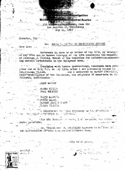
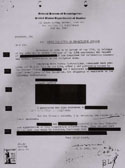
The names Adrian Scott and Edward Dmytryk were not, however, pulled out of a hat. In May, as soon as Hoover agreed to provide HUAC with confidential Bureau information, Congressman Thomas submitted an initial list of eleven names—presumably those Hollywood subversives who most concerned him. Both Scott and Dmytryk were included, along with nine leading lights of Hollywood's progressive émigré community, including Bertolt Brecht, Hanns Eisler, Paul Henreid, Peter Lorre, and Salka
Smoking gun memo, AS FBI File
The names Adrian Scott and Edward Dmytryk were not, however, pulled out of a hat. In May, as soon as Hoover agreed to provide HUAC with confidential Bureau information, Congressman Thomas submitted an initial list of eleven names—presumably those Hollywood subversives who most concerned him. Both Scott and Dmytryk were included, along with nine leading lights of Hollywood's progressive émigré community, including Bertolt Brecht, Hanns Eisler, Paul Henreid, Peter Lorre, and Salka
 Smoking gun memo, ED FBI File
Viertel. It is an intriguing list: all European émigrés, mostly Jewish, noted for their antifascist political activism—and then there's Scott and Dmytryk.18 Given the blatant anti-Semitism of key HUAC members and their espousal of the "Jewish-Communist conspiracy" theory, it cannot be a coincidence that the only two Americans on this list were the producer and director of Crossfire, a film exposé of American anti-Semitism and native fascism. Scott and Dmytryk appear to have been specifically targeted by HUAC not because they were Communists—though that certainly didn't help their case—but because of their work on Crossfire, a very dangerous film in the eyes of HUAC.
Smoking gun memo, ED FBI File
Viertel. It is an intriguing list: all European émigrés, mostly Jewish, noted for their antifascist political activism—and then there's Scott and Dmytryk.18 Given the blatant anti-Semitism of key HUAC members and their espousal of the "Jewish-Communist conspiracy" theory, it cannot be a coincidence that the only two Americans on this list were the producer and director of Crossfire, a film exposé of American anti-Semitism and native fascism. Scott and Dmytryk appear to have been specifically targeted by HUAC not because they were Communists—though that certainly didn't help their case—but because of their work on Crossfire, a very dangerous film in the eyes of HUAC.
18Related document:
Scott and Dmytryk, telegram to Thomas (PDF)
Certainly Scott and Dmytryk both believed, at least in 1947, that this was the reason that they had been targeted by HUAC.19 Both were very aware of the Rankin's virulent anti-Semitism and were particularly swayed by the fact that HUAC investigators, during their visit to RKO that summer, had specifically asked to view Crossfire. Upon receiving their subpoenas, Scott and Dmytryk sent a telegram to HUAC, inviting its members to screen the film to determine for themselves whether Crossfire was an "un-American" document: "Millions of Americans have seen Crossfire, our picture opposing anti-Semitism. We invite you and the entire Committee to a showing to be held at your convenience so that when we appear before your body we may discuss with you what action you propose to take against the un-American doctrine of racism which subverts all constitutional liberties which decent Americans hold sacred." HUAC did not reply, and Scott noted, "We expected them to refuse our invitation . . . to refuse to discuss measures by which the practice of anti-Semitism could be abolished. To do this would be incompatible with the committee's bigoted record and bigoted support."20
Progressive Hollywood Fights Back
19In their challenge to HUAC and the Alliance, the Hollywood radicals and their liberal allies relied on wartime popular nationalism's rallying cry of "freedom," calling for "freedom of the screen" and condemning the tactics of the Alliance and HUAC as "thought control." In July 1947, months before any subpoenas had been issued, the Progressive Citizens of America and the University of California at Los Angeles sponsored a well-attended conference entitled "Thought Control in America," at which both radicals and liberals discussed the impact of conservative intimidation on a wide range of fields—on the film industry, of course, but also on science and medicine, law, journalism, and radio.21
Related document:
Adrian Scott, "You Can't Do That" (PDF)
In a paper entitled "You Can't Do That," Scott used his experience with the production of Crossfire as a window onto issues of "freedom of the screen" and censorship in the film industry. Warning that progressive filmmaking was under assault by the forces of reaction, he urged his audience not to be complacent: "Our fear makes us beautiful targets. . . . We are magnificently adjusted to bans, and ripe for more bans."22
20In their writings and speeches, both at the Thought Control conference and into the fall, the Hollywood progressives emphasized three key themes, each powerfully informed by their Popular Front vision: 1) their own Americanism and the historical tradition of radical dissent in the United States; 2) the parallels between the current anti-Communist crusade in America and the rise of European fascism; and 3) the dangers of censorship and its negative impact on Hollywood filmmaking. Historian Norman A. Markowitz sees the postwar reliance on Popular Front analyses and rhetoric as a backward-looking mistake: "On the defensive after 1945, the popular front could only invoke the increasingly hollow slogans of the past, seeking to sustain fears of Fascism in a Hitlerless world."23 In hindsight, of course, Markowitz is quite correct. However, I believe that he underestimates the extent to which, at least in 1947, the slogans of the Popular Front still resonated profoundly, not only for Hollywood progressives, but for a substantial segment of ordinary Americans. As the public response to Crossfire suggests, the Popular Front vision of a pluralist, democratic, tolerant America was widely embraced. In addition, I think that Markowitz's critique fails to recognize the profound importance of fascism in shaping the political perspectives of American radicals—indeed, of the American public as a whole. For most Americans, even in the late 1940s, fascism represented the ideological Other against which they understood and self-consciously constructed their own political culture and imagined community, "their" Americanism. For this generation of American radicals, antifascism was their political raison d'etre; they could not, quite simply, interpret the postwar events in any other way. For them, the slogans of antifascism were not "outworn"—indeed, they had, perhaps, even more emotional resonance when the fascist menace seemed to have infected their America and to threaten them personally. They were, of course, mistaken in their belief that ordinary Americans shared their antifascist fervor. By the 1950s, Communism, equated with fascism under the rubric of totalitarianism, was perceived by most Americans as a profound threat to the American Way of Life, and the wartime antifascist impulse translated only too easily into the postwar anti-Communist crusade.24
21In 1947, however, it was not quite so clear which path America would take, and the Hollywood progressives, clearly believing that "good Americans" still could be counted on to rally behind their antifascist Popular Front vision, began to raise the cry of alarm about the un-American danger represented by HUAC. Scott and Dmytryk, along with the other members of the Nineteen, understood HUAC, not as a legitimate arm of the national government, but as a key component in a broad-based reactionary front intent on rolling back the New Deal, containing militant unionism, and crushing the American Left. To them, it was quite clear that the Committee's tactics were both un-American and potentially fascist. Thus, in planning their defense strategy, the Nineteen agreed that they not only wanted to keep their jobs, stay out of jail, and avoid naming names, but also that they wanted to publicly expose HUAC as a tool of reaction. The Nineteen also agreed early on to present a united front in their defense—though they continued to argue among themselves about strategy throughout the hearings and after.25 Though individuals among the ten men who would eventually be called to testify hired separate counsel, the attorneys worked together as a team and represented a broad political spectrum—a miniature Popular Front against fascism. Ben Margolis, Charles Katz, and Martin Popper were all active members of the leftist National Lawyers Guild, with significant civil liberties experience and, probably, ties to the Communist Party. Robert Kenny and Bartley Crum, as liberals with distinguished records of public service, were chosen as the spokesmen for the 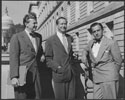 Adrian Scott, Bartley Crum, and Edward Dmytryk
Nineteen. Kenny, then president of the NLG, had served as California's Attorney General from 1943 to 1947; Crum, a liberal Republican hired by Scott and Dmytryk, had worked as Wendell Wilkie's campaign aide and had recently published a book, Behind the Silken Curtain, about his efforts to open Palestine to Jewish Displaced Persons.26 From the beginning, their attorneys warned the Nineteen that their case could only be won in the Supreme Court and that they should expect to be charged with contempt of Congress and to lose in the lower courts.27
Adrian Scott, Bartley Crum, and Edward Dmytryk
Nineteen. Kenny, then president of the NLG, had served as California's Attorney General from 1943 to 1947; Crum, a liberal Republican hired by Scott and Dmytryk, had worked as Wendell Wilkie's campaign aide and had recently published a book, Behind the Silken Curtain, about his efforts to open Palestine to Jewish Displaced Persons.26 From the beginning, their attorneys warned the Nineteen that their case could only be won in the Supreme Court and that they should expect to be charged with contempt of Congress and to lose in the lower courts.27
22Recognizing that they were waging a war of public relations as well as law, the Nineteen and their attorneys vigorously debated the options open to them. One strategy would have been to simply denounce the Committee as unconstitutional, a tactic sure to cost them public support. Another option was to deny Communist Party membership, but fears of perjury charges led them to reject this strategy. A third tactic, favored by the more militant of the Nineteen, was to proudly acknowledge their political affiliations and activities; this strategy, however, would have legally obligated them to answer HUAC's questions about other Hollywood leftists, which they unequivocally refused to do. A fourth option was to take the Fifth Amendment, which the Nineteen quickly rejected as morally and politically abhorrent. They did not want the American public to think that they had something to hide or that they believed, even implicitly, that membership in the Communist Party was criminal or shameful. Thus the Nineteen ultimately chose to rely on the First Amendment's protection of free speech and free association, a strategy with a noble legal and political history. As Ceplair and Englund explain,
Standing on such hallowed ground gave the Nineteen the moral, historical and legal basis they needed to challenge the Committee's jurisdiction without appearing to be captious, self-seeking wreckers of congressional procedures. More fundamentally, the tradition of the First struck a resonant chord in the "unfriendly" witnesses themselves. Both in their public and private statements, they constantly reiterated their regard for their responsibilities as American citizens, defenders of the Constitution, and bearers of the radical tradition of Zenger, Paine, Altgeld, Debs.28
23
Related document:
Scott statement to HUAC (PDF)
Having agreed on a legal-defense strategy, the Nineteen next discussed its presentation before HUAC—particularly the "degree of politeness to accord the inquisition." Ultimately, they agreed that each would read a personal statement before answering the Committee's questions. To ensure that all points in their anti-HUAC argument would be addressed, the Nineteen worked in concert to prepare their statements for the hearings.29 A number of the group focused on the similarities to European fascism; others focused on the Bill of Rights and the tradition of dissent in American history. Dmytryk explained the un-American workings of the blacklist, while Scott, not surprisingly, focused on the "'cold war' now being waged by the House Un-American Activities Committee against the Jewish and Negro people." Drawing on HICCASP's research on the racist and anti-Semitic views of John Rankin, Scott challenged the Americanism of the Committee itself: "Let the committeeman say he is not anti-Semitic. But the rabble rousing anti-Semitic Gerald L. K. Smith publicly approves and supports him. Let the committeeman say he is not against the colored people. But the anti-Negro Ku Klux Klan and all hate groups love and work for him." In contrast, Scott noted that the nineteen men on trial not only "say they are against minority oppression, they do something about it," listing the antiracist films of the Nineteen: Robert Rossen's They Won't Forget and Body and Soul; Albert Maltz's Pride of the Marines and The House I Live In; Ring Lardner Jr.'s The Brotherhood of Man; Lewis Milestone's Of Mice and Men; Lester Cole's None Shall Escape; as well as his own Crossfire.30
24
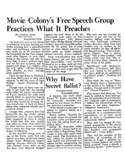
Initially, the response to the Nineteen was quite positive, and the men believed that they had broad support throughout the film community. After HUAC issued its subpoenas, the left-leaning Progressive Citizens of America immediately rallied to the cause, but Hollywood liberals also organized to support the Nineteen. Led by John Huston and William Wyler, they created the Committee for the First
 Cecilia Ager, "Movie Colony's Free Speech Group" PM
Amendment (CFA), the second critically important organization in the anti-HUAC campaign. Abraham Polonsky, representing the radical faction of a largely liberal group, attended the formal founding meeting of the CFA at the home of Ira Gershwin: "You could not get into the place [it was so crowded]. The excitement was intense. The town was full of enthusiasm because they all felt they were going to win. Every star was there." Through radio broadcasts, pamphlets, splashy ads in the trade press, and star appearances, the CFA led the public relations campaign in support of the Nineteen, or more precisely, in defense of the film industry. At this point, prior to the hearings, these two causes appeared identical, and the heady days of the Popular Front seemed revived in the face of the external threat.31
Cecilia Ager, "Movie Colony's Free Speech Group" PM
Amendment (CFA), the second critically important organization in the anti-HUAC campaign. Abraham Polonsky, representing the radical faction of a largely liberal group, attended the formal founding meeting of the CFA at the home of Ira Gershwin: "You could not get into the place [it was so crowded]. The excitement was intense. The town was full of enthusiasm because they all felt they were going to win. Every star was there." Through radio broadcasts, pamphlets, splashy ads in the trade press, and star appearances, the CFA led the public relations campaign in support of the Nineteen, or more precisely, in defense of the film industry. At this point, prior to the hearings, these two causes appeared identical, and the heady days of the Popular Front seemed revived in the face of the external threat.31
25
Related document:
AS FBI File, June 29, 1949 (PDF)
Not surprisingly, the FBI was watching avidly, attending public events, collecting literature, compiling names, and recording it all in their files. And there were other ominous signs on the horizon as well. The CFA leaders, for example, determined to maintain the "purity" of their organization, refused to open its membership to Communists. More troubling by far was the ambivalent position taken by the Screen Writers Guild. Though adamantly opposed to HUAC, the Guild's liberal leadership, concerned with the reputation of their union, saw the hearings as an opportunity to set the record straight and to publicly separate themselves from the radicals. As SWG president Emmet Lavery, who had also been subpoenaed by HUAC (though not as an "unfriendly"), announced prior to the hearings, "[I]n the matter of individual activities of Guild members, either within or outside the industry, the individual defense or individual presentation is a matter for each individual witness. As the chief executive officer of the Guild, it is not my purpose at Washington to act either as 'prosecutor' or 'defending counsel' for individual witnesses before the Committee."32
26Nevertheless, on the eve of the hearings, the Nineteen believed that they enjoyed wide support among their colleagues in the industry. Perhaps the high point of the united front against HUAC was a mass rally held on October 15 at the Shrine Auditorium in Los Angeles. This "Keep America Free!" rally was attended by nearly 7,000 people and featured a wide array of both liberal and radical speakers, who echoed the militant language and analysis of the Nineteen. For example, Robert Ryan read a resolution calling for the immediate dissolution of HUAC: "We protest the threat to personal liberty and the dignity of American citizenship represented by this police Committee of Dies, Wood, Rankin and Thomas. We demand, in the name of all Americans, that the House Committee on Un-American activities be abolished, while there still remains the freedom to abolish it."33 Liberal radio writer Norman Corwin made explicit the parallels with European fascism: "The screen is the most important and far-reaching medium of culture in the world today. And a free culture, by its very existence, is a bulwark against tyranny. That is why Hitler, Mussolini, and the Japs went after culture with guns, nooses, guillotines, and lethal gas." Drawing on the inclusionary logic used by Pastor Neimoller to galvanize antifascist resistance in Germany, Corwin argued:
This is my fight just as much as it's the fight of Adrian Scott and Darryl Zanuck and L. B. Mayer and Evelyn Keyes and you and the former vice-president who was denied the right to speak in the Hollywood Bowl, and the Negro who is denied the right to sit on certain seats in a bus, and the group of painters whose canvasses were not permitted to be shown in foreign countries, and the singer who was not permitted to sing in Peoria, and the member of the Anglo-American Commission on Palestine who was not permitted to speak in a town in upstate California, and the accused clerk who is not permitted to face his accuser.34
Republican attorney Bartley Crum, who had been hired by Scott and Dmytryk, spoke on the American ideals held by the Nineteen: "These men know a great deal about Americanism and about the struggles by which it was won. . . . It is my proud privilege to tell you that each and every man we represent has individually determined he will not yield at any point in upholding the constitutional rights of the American people and of the industry of which he is a part."35
27Members of the Nineteen spoke as well. Director Irving Pichel, noting the long history of reactionary activism among Alliance members and particularly their opposition to the New Deal, insisted that the hearings were a battleground over competing definitions of Americanism and defended the democratic principles for which the Nineteen stood:
The American ideals to which I and my colleagues subscribe are those taught to every school child and to every applicant for citizenship. They are embodied in the Declaration of Independence, in the Preamble to the Constitution, in . . . the Bill of Rights. If we are wrong, we must have misread those great promises. We must have misunderstood the intentions of the great founders of this greatest of nations. We must have misunderstood the course and meaning of our whole history.36
28Similarly, Albert Maltz attacked the reactionary politics of the Committee members: "And what are their standards of loyalty? Do we find on their lips the words of Tom Paine, Thomas Jefferson or Abraham Lincoln? No, we find the following from Rankin: 'The Ku Klux Klan is an American institution, its members are Americans.' And we find a Committee on Un-American activities voting 5 to 1 not to investigate the Ku Klux Klan." Maltz, too, represented their fight against HUAC as a battle to define true Americanism:
Loyalty to them demands an absolute support of the status quo in American life. Price rigging, monopoly profit, lynching, inflation, anti-Semitism—none of these is un-American or requires investigation. But let anyone advocate any social change for the welfare of the people—let him advocate Federal housing or an anti-lynching bill—let him be a supporter of Loyalist Spain or of free suffrage in the South—and these men will list him as a disloyal subversive.
Comparing HUAC to "a thought police, a Gestapo," Maltz argued, "It proposes to tar and feather any social idea that is liberal or humane, and to slander any artistic work that expresses the concept of human brotherhood. Using the weapons of hysteria, intimidation and political blackmail, it has become a prosecuting committee of hatchet men on behalf of social reaction."37
29
Related document:
Scott, "The Real Object of the Investigation" (PDF)
Adrian Scott also spoke, hitting hard on the issue of freedom of the screen. Gene Kelly, the master of ceremonies for the rally, introduced him as "a producer of a new school," adding, "Mr. Scott has the subversive audacity to believe in the Bill of Rights and simple human dignity, and he believes that the Thomas-Rankin Committee is a patriotic masquerade, and that it's time the masks were removed."38 In Scott's address, entitled "The Real Object of the Investigation," he insisted that the "absurd charges" and "hysterical headlines" were designed not only to smear the Nineteen, but to frighten the studio executives into "lifeless conformity." Pointing out that nothing gets past the front office, that "there is no such thing as a Communist picture," he noted that "there have been pictures calling for a better world, calling for more understanding among people, more tolerance, less lynching and more forthright use of citizenship." For Scott, it was abundantly clear that HUAC intended to censor such "un-American" representations:
Ideas unsympathetic to the Un-American Committee or to the [Alliance] will automatically be rejected—or if a few should be a subject of consideration, they will be referred to the fanatic minority within the [Alliance] for approval. . . . This means that this enterprise which subsists on . . . originality and showmanship . . . will turn their sovereign rights over to a minority—a minority within whose ranks is a white supremacy advocate and a leading anti-Semite. This means that ideas—the very life blood of the industry—are shackled and that means, finally, that freedom of the screen will be no more.39
30On the eve of the hearings, then, the Nineteen were confident that their cause was just and that they had the support of the industry and even the American people. After the meeting at the Shrine, a friend wrote to Maltz, confessing that the mass singing of "America" had moved him to tears and assuring him that HUAC eventually would be "smashed" by the people: "The goddamned, ornery, pungent, pugnacious, misled, stubborn, god-loving, coke-drinking, movie-going, ass-licking, and a million-to-one-shot liberty-hungry American people are going to do it."40
31
Related document:
Scott's notes from conversations with Schary (PDF)
Scott and Dmytryk were particularly reassured following several conversations with Dore Schary. Scott's notes record that Schary, concerned but supportive at the first meeting, promised that both he and Rathvon were "with him." Schary had already come out publicly in support of "freedom of the screen," arguing before a gathering of film exhibitors, "I believe that all picture personalities, picture makers and organizations must develop in this postwar world a strength of purpose and character that has been lacking. They must refuse to be intimidated by un-Americans who talk about Americanism, and by special groups that have everything to lose by the screen's becoming articulate." Now, he assured Scott that RKO and the entire film industry were "prepared to oppose the committee" and its attack on progressive filmmaking. At this point Schary, though not considered one of the unfriendly Nineteen, was quite concerned about his own position vis-à-vis the Committee. Investigators had visited Schary at the studio and, after screening Crossfire
Related document:
DS FBI File, January 2, 1951 (PDF)
and The Farmer's Daughter, pronounced them "pro-communist." Schary had also contributed to the HICCASP exposé of Rankin, and he feared that this would be used against him during the hearings. During this conversation, Schary assured Scott and Dmytryk that the studio would not—indeed, could not, legally—inquire into their political ideas and that RKO was only interested in the men's talent and productivity. Though Schary advised them to "have good manners" during the hearing, he did not ask what Scott planned to say to the Committee.41
32Schary's recollection of their meetings, written long after the fact, was rather different. In his autobiography, he claimed to have been quite surprised that Scott and Dmytryk had been subpoenaed as "unfriendlies," since neither "had been active in any of the groups I had been involved in and as far as I knew had not been part of any activity in left-wing action." Thus, according to Schary, the three joked casually about their summonses: Scott and Dmytryk assured him that they had never been members of the Communist Party, while Schary assured them that he had never been a member of the Nazi Party. For Schary, however, the fun ended when they had lunch with attorney Charlie Katz, whom Schary believed to be a Communist supporter. Katz warned Schary that HUAC would produce Party cards for Scott and Dmytryk, and possibly even for Schary himself. Though he doubted this would happen, Schary replied that "if they did, then the jig was up for everyone in America; if a congressional committee would deliberately make up false membership cards in any party, we were doomed." When Katz asked to see Schary's statement to the Committee, he became suspicious:
Related document:
Schary's note to Scott (PDF)
"I sensed he was attempting to use me and I began to doubt Scott and Dmytryk's personal testimony to me."42 Nonetheless, Scott's personal papers contain a note of encouragement from Schary. Though undated, the note's warm tone suggests Schary wrote it prior to the hearings:
Every guy lives his life his way and does his job his way. My one hope is to live and do without hurting and intimidating other guys of good will who I respect and like, such as you and Eddie. We will disagree, in the nature of things, on details, in the future, but I hope and I will try that we never hurt each other. Thanks for your pledge and you know that you have mine.43
Hollywood versus HUAC: Round One
33Ceplair and Englund describe the hearings in Washington, D.C. as a drama in four acts, carefully orchestrated by the Committee. Act One opened with studio executive Jack Warner, the first witness as the hearings began on October 20, 1947. The Committee was clearly gambling that Warner would again break ranks with the moguls' united front, as he had the previous May in his closed-session testimony. And Warner obliged, proclaiming his own patriotism and his horror of Communism and insisting that he had already identified and fired twelve obviously Red screenwriters, including many of the Nineteen, as well as John Wexley, Clifford Odets, Irwin Shaw, and even the staunchly anti-Communist Emmet Lavery. Everyone—save the members of HUAC and the Alliance—was horrified by Warner's "craven performance" before the Committee, and Johnston "went out of his way to inform the Nineteen that he and his confreres 'are embarrassed by the fact that Jack Warner . . . made a stupid ass of himself.'"44 The studio executives who testified later, however, did not perform more admirably. As Schary remembered:
Some of the witnesses for the producers, coming to boil under the heat of the questioning . . . quickly abandoned their simple statement of independence and went into long protestations about their own patriotism and long harangues on how much they hated Russia and Communism. It was a pitiful spectacle to see men who had given so much of their time and energy to American institutions being dragooned by sharp questioning into defending their own loyalty as if it were on trial.45
34Act Two featured the very friendly witnesses, largely Alliance members and sympathizers, including Sam Wood, Walt Disney, IATSE leader Roy M. Brewer (who testified for two hours), Lela Rogers (mother of Ginger), and writer Ayn Rand. Their testimony was not new to the Committee, nor was it much of a surprise to the Hollywood progressives, who were all too familiar with the political views of the industry's right wing. Nevertheless, their testimony in Washington was lengthy and unchallenged, though exceptionally vituperative and largely unsubstantiated. Act Three starred a series of Hollywood's leading men—Gary Cooper, Robert Taylor, Ronald Reagan, Adolphe Menjou, and Robert Montgomery—who clearly were subpoenaed for their ability to generate headlines and attract public attention, rather than for any real expertise on Hollywood Communism. With high-powered stars on hand, the scene was a circus. As Reuters news service reported, "Autograph hunters thronged the corridors . . . [and] an active black market was being organized for seating. Newsreel, broadcasting, television paraphernalia cluttered the floor. . . . Committee members and witnesses were dazzled by the glaring lights."46
35Over the weekend "intermission" separating the last of the friendly witnesses and the opening of Act Four, the testimony of the "unfriendlies," the Hollywood progressives kicked off their anti-HUAC publicity campaign. Under Committee on the First Amendment auspices, a planeload of Hollywood luminaries—including John Huston, Gene Kelly, John Garfield, Humphrey Bogart, Lauren Bacall, and most interestingly, Richard Brooks—flew to Washington in a widely publicized show of solidarity. The private plane (chartered at a cut rate from TWA mogul Howard Hughes) touched down several times en route, and the stars were met by throngs of sympathetic reporters and fans. John Huston recalled, "We got the feeling that the country was with us, that the national temper resembled ours—indignant and disapproving of what was going on." "The airport crowds were large and vociferous—cheers went up—God, it was exciting," Lauren Bacall remembered. "I couldn't wait to get to Washington. Wouldn't it be incredible if we really could effect a change—if we could make the Committee stop?"47
36
Related document:
The Other Side of the Story (PDF)
Defenders of the Nineteen produced a constant barrage of media materials, including a daily newspaper, The Other Side of the Story, that kept Hollywood updated on the hearings and the issues. In addition to the personal appearances of the stars, the Committee for the First Amendment also sponsored two live nationwide radio broadcasts, titled Hollywood Fights Back, on October 26 and November 2.48 A constellation of liberal stars lent their voices to the cause, challenging particularly the Committee's representation of the film community and Hollywood message films as un-American. In the first broadcast, Lauren Bacall defended Crossfire: "This is Bacall. Have you seen Crossfire yet? Good picture? It's against religious discrimination. It is one of the biggest hits in years. The American People have awarded it four stars, but the un-American Committee gave the men who made it three subpoenas." Screenwriter Moss Hart, pointing with pride to his work on Gentleman's Agreement, said, "Now I'm wondering if my employers and I were not fortunate to finish that project before Mr. Thomas began his fantastic hearings, since there seems to be evidence that a motion picture which tells the truth about our country, right or wrong, is considered heresy by the Committee on Un-American Affairs." And Humphrey Bogart reported ominously in the final broadcast: "We sat in the committee room and heard it happen. We saw it and we said to ourselves, 'It can happen here!'"49
37On Monday morning, October 27, John Howard Lawson, the "high lama" of the Hollywood Communists, as Dmytryk characterized him, was called to testify first. From the beginning, it was clear that the unfriendlies would be treated very differently from the friendlies. Lawson's request to read his statement into the record—a privilege granted to many of the friendly witnesses—was immediately denied; the Committee clearly had "no intention of providing a soapbox for the radicals' attempt to discredit it." As Lawson parried the Committee's questions and tried to read his statement anyway, Thomas banged his gavel while Robert Stripling, HUAC's lead counsel, demanded repeatedly, "Are you now or have you ever been a member of the Communist Party?" Frustrated, Lawson replied angrily, "It is unfortunate and tragic that I have to teach this committee the basic principles of Americanism," as Thomas, relentlessly pounding his gavel, shouted over him, "That is not the question. That is not the question. Are you now or have you ever been . . . ?" Lawson shouted back, "I am answering in the only way that any American citizen can answer a question that absolutely invades his rights." After half an hour of rancorous battle, Thomas declared Lawson in contempt of Congress and ordered the sergeant at arms to forcibly escort the screenwriter from the chamber.50
38
Related document:
Scott statement to HUAC (PDF)
Over the next two days, HUAC called ten more unfriendlies to the stand—Dalton Trumbo, Albert Maltz, Alvah Bessie, Samuel Ornitz, Herbert Biberman, Edward Dmytryk, Adrian Scott, Ring Lardner Jr., Lester Cole, and Bertolt Brecht—for a replay of the treatment accorded Lawson. Only Maltz was allowed to read his full statement; the others were denied that right or, like Scott, were cut off mid-text.51 Maintaining their united front, each of the men in turn parried questions about their membership in the Party or the Guild, hoping (in vain) that by answering "in their own way" they might avoid contempt citations or at least maintain public sympathy. Though their individual performances varied—some, like Trumbo and Maltz, were bitingly sarcastic, others, like Biberman and Cole, angrily belligerent, and others, like Ornitz and Scott, composed and even civil—each of the men challenged the Committee's right to interrogate private citizens about their political beliefs or affiliations. Dmytryk, for example, stammered, "I have been advised that there is a question of Constitutional rights involved. . . . I think that what organizations I belong to, what I think, and what I say, cannot be questioned by this committee," while Scott quietly insisted, "I believe I should not engage in any conspiracy with you to invade the First Amendment." After each unfriendly witness, save Bertolt Brecht, was cited for contempt and led away, HUAC investigator Lewis J. Russell produced evidence of each man's subversive activity and often, documentation of his membership in the Party.52 When called to the stand, Scott tried to read his statement, which denounced the Committee for its "thought control" tactics, which put America on the road to fascism:
By slander, by vilification, this Committee is attempting to frighten and intimidate these men and their employers; to silence those voices which have spoken out for the Jewish and the Negro people and other people. The Committee wants these eloquent voices silenced. This is the cold war now being waged against minorities. The next phase—total war against minorities—needs no elaboration. History has recorded what happened in Nazi Germany. . . . For myself and my colleagues, we will not be intimidated. We will not be frightened. We will not permit our voices to be put into moulds or into concentration camps. We will continue to lend our voices so that fundamental justice will obtain for Jews, Negroes and for all citizens.53
Thomas cut Scott off mid-speech, and after reading through it himself, he refused to allow Scott to continue, announcing, "This may not be the worst statement we have ever received but it is almost the worst." Following Scott's testimony, HUAC investigator Louis J. Russell produced a photostat of a 1945 CPA card, #47200, issued to Scott in the fall of 1944, and a 1946 CPUSA registration card, #35394, issued in the fall of 1945.54
39
Related document:
AS FBI File, June 29, 1949 (PDF)
This evidence of Communist ties utterly sabotaged the First Amendment strategy adopted by the Nineteen and fundamentally shifted the public perception of the unfriendly witnesses. Instead of American citizens standing on their constitutional right to freedom of speech and association, the Ten now appeared to be exactly as HUAC and the anti-Communist front described them: duplicitous radicals who tried to manipulate public opinion and undermine American ideals and institutions. How ironic, then, that the evidence presented against them was itself the product of illegal activity by an arm of the American justice system and was secretly shared with another governmental body for propagandistic purposes.
40In the eyes of many of the liberal bystanders, however, the behavior of the Ten was far more damaging than the membership cards. Indeed, following the hearings, some in Hollywood implied that the Ten brought their expulsion from the film industry on themselves through their "bad manners" as much as their political commitments. Schary, for example, later argued,
The ten "unfriendly witnesses," some of whom I knew as sober and thoughtful men, of considerable talent, also caved under the pressure (whether by design, as some people thought, or by panic, as others maintained—I am not certain) and also lost sight of the issue. . . . The so-called Hollywood Ten hardly contributed anything to the dignity of the occasion. If the intent of the ten witnesses was to provide a solemn forum for presenting the issue to the American public, they failed miserably.
While he supported their reliance on the First Amendment, Schary believed that the unfriendlies should have called a press conference following their testimony before HUAC to "explain why they didn't answer the Committee but add that they had no desire to cover up their identifications." He maintained that since Party membership was legal in America, there was no reason not to "tell the world which ones of the ten were Communists. Such a stand might have clarified the question."55
41Nonetheless, Schary's position on the stand was uncompromising: "Up until the time it is proved that a Communist is a man dedicated to the overthrow of the government by force or violence, or by any illegal methods, I cannot make a determination of his employment on any other basis except whether he is qualified best to do the job I want him to do." Schary also vigorously defended Scott and Dmytryk: "At no time in discussions—or films—have I heard these men . . . make any remark or attempt to get anything subversive into the films I have worked on with them. I must say that in honesty."56 Schary's position on the stand was a high point for Hollywood liberals and radicals alike. Director Jules Dassin enthused, "Please let me express my great esteem for you. . . . You were just beautiful on that stand. You made many people very proud." Walter Wanger sent him a telegram on October 29 (the day Schary testified): "Congratulations on your great stand today. . . . You stood out like a sore thumb amongst your colleagues."57
42The Nineteen and their attorneys fully expected that both Schary and Eric Johnston, though nominally friendly witnesses, would make a strong stand against HUAC. Indeed, before the hearings opened, Johnston, "wearing his liberal cap," met privately with the Nineteen and their attorneys, reassuring them that the MPPA was behind them: "As long as I live I will never be a party to anything as un-American as a blacklist, and any statements purporting to quote me as agreeing to a blacklist is a libel upon me as a good American. . . . Tell the boys not to worry," said Johnston. "There'll never be a blacklist. We're not going to go totalitarian to please this committee."58 Consequently the statement given by Johnston, who followed Lawson to the stand on the first day of the unfriendlies' testimony, provoked alarm and dismay. This was the Nineteen's first inkling that the studios might cave in to HUAC's pressure. Johnston's statement on behalf of the industry executives (later published as a pamphlet by the MPPA) sounds at first like a bold challenge to the premises of the Committee. He roundly criticized the damage done by spurious and unsubstantiated charges against individuals and the film industry as a whole and particularly the Committees' refusal to allow them to refute the charges publicly or cross-examine witnesses. Rallying around the issue of free speech—the "keystone in our freedom arch"—Johnston argued that "intimidation or coercion" were just as effective as legislation in curtailing free speech: "You can't make good and honest motion pictures in an atmosphere of fear." "I intend to use every influence at my command to keep the screen free," he boldly proclaimed. However, he also made very clear that the MPPA and the unfriendlies did not necessarily understand "freedom of the screen" in the same way: "We insist on our right to decide what will or will not go in our pictures. We are deeply conscious of the responsibility this freedom involves but we have no intention to violate this trust by permitting subversive propaganda in our films." Reiterating that "an exposed Communist is an unarmed Communist," Johnston argued that such exposure must be handled responsibly, in the "traditional American manner" of fair play and the rule of law, rather than by "thoughtless smearing by gossip and hearsay." Thus, he challenged the Committee, "Expose Communism, but don't put any American who isn't a Communist in a concentration camp of suspicion. We're not willing to give up our freedoms to save our freedoms."59
43Johnston also used his statement to reiterate his liberal corporatist vision, drawing a public distinction between the racist and reactionary Americanism of HUAC and his own internationalist, pluralist, democratic "New Americanism":
Communism must have breeding grounds. Men and women who have a reasonable measure of opportunity aren't taken in by the prattle of Communists. Revolutions plotted by frustrated intellectuals at cocktail parties won't get anywhere if we wipe out the potential causes of Communism. The most effective way is to make democracy work—for greater opportunity—for greater participation—for greater security for all people.
For Johnston, democracy, opportunity, participation, security could be summed up in one word: abundance. "Freedoms walk hand in hand with abundance. That's been the history of America. It's been the American story. It turned the eyes of the world on America, because America gave reality to freedom plus abundance when it was still an idle daydream in the rest of the world." Johnston was certain that the promise of abundance could overcome the appeal of Communism: "If we fortify our democracy to lick want, we'll lick Communism—here and abroad. Communists can hang all the iron curtains they like, but they'll never be able to shut out the story of a land where free men walk without fear and live with abundance."60
44On October 30, J. Parnell Thomas abruptly and inexplicably declared the hearings closed, without calling the remaining unfriendlies, and the Hollywood Nineteen became the Hollywood Ten. In his closing speech, Thomas warned that "there are many more [witnesses] to be heard," and promised that HUAC's investigation of Hollywood would continue at a later date:
Ten prominent figures in Hollywood [against] whom the Committee had evidence were members of the Communist Party were brought before us and refused to deny that they were Communists. It is not necessary for the Chair to emphasize the harm which the motion-picture industry suffers from the presence within its ranks of known Communists who do not have the best interests of the United States at heart. The industry should set about immediately to clear its own house and not wait for public opinion to force it to do so.61
The Road to the Blacklist
45In hindsight, the fallout from the HUAC hearings—the eventual capitulation of the studio executives to the pressures of HUAC, the imposition of the blacklist, the defection of the Screen Writers Guild and other traditional bastions of liberal support, the slow but inexorable collapse of the Popular Front—appear inevitable. However, historians Ceplair and Englund powerfully argue that a united front among the studio executives, the industry guilds, liberal activists, and the Nineteen might well have prevented that. Certainly, in late October and early November of 1947, it still seemed possible that Hollywood might emerge, as it had from earlier battles with HUAC, a bit bloodied but essentially unbeaten.
46Perhaps most heartening to Hollywood progressives and moguls alike was the overwhelming evidence that public opinion was running against HUAC. The MPPA, as always assiduous in monitoring the public pulse, compiled nearly two hundred editorials from newspapers across the country that clearly revealed a backlash against the hearings into subversion in Hollywood. Though the national dailies of major cities—as well as a significant number of smaller newspapers—tended to accept the need for such an investigation, given the danger that Communism seemed to present to national security, these opinion-makers also had significant questions about the constitutionality of HUAC's tactics and the impact on civil liberties and First Amendment freedoms. The New York Herald Tribune, for example, argued:
There are, without doubt, circumstances under which such an investigation as this one would be proper. If the moving pictures were undermining the American form of government and menacing it by their content, it might become the duty of Congress to ferret out the responsible persons. But clearly this is not the case—not even the committee's own witnesses are willing to make so fantastic a charge. And since no such danger exists, the beliefs of men and women who write for the screen are, like the beliefs of any ordinary men and women, nobody's business but their own, as the Bill of Rights mentions. Neither Mr. Thomas nor the Congress in which he sits is empowered to dictate what Americans shall think.62
47Many newspapers, echoing the "freedom of the screen" arguments voiced by Hollywood progressives, argued that the HUAC investigation would have a deleterious effect on film content and might ultimately lead to censorship of the film industry (and possibly other media as well). The New York Times, for example, suggested ominously that the hearings may "succeed in identifying as 'communist' any element of criticism or protest in the films against any aspect of American political, social or economic life; if this happens, and the investigation creates fear in Hollywood, which has often been accused of timidity in dealing with public questions, then the screen is consigned to mere entertainment on the most trifling of premises."63 Others shared the film progressives' belief that HUAC's real target was the movies exposing racism and other social ills. Noting that Hollywood had produced no pro-Soviet movies since the end of the war, the Pittsburgh Post-Gazette editors warned:
But there have been films which pointed out flaws in our political, social and economic system. Is this critical attitude the real target of the House Un-American Activities Committee? If it is, the committee is striking at the fundamental freedom of expression. If the movies are to be called un-American because they dare point out failures to attain the standards set in the Constitution, what will be the next step—censorship of books, plays, press and schools?64
48A second area of significant concern was the "un-American" tactics employed by the Committee, which seemed to many to mirror the repressiveness of totalitarianism. The Charleston Post warned, for example, "Let us not sink into a system such as prevails in totalitarian countries in which a man is guilty until he proves his innocence, and where it is a crime to hold views frowned on by the governing regime."65 While recognizing the importance of identifying and tracking Communists in the midst of America, the Louisville Courier-Journal argued that this information should not be gained at the expense of civil liberties:
The Soviets regard civil liberties as a mess of pottage; we Americans cherish them as our birthright. On that point rests the most vital difference between the Soviet and the American systems. It would be tragic if America, in fear of Communism, threw away the very treasure which separates and preserves us from the horrors of the police state.66
49The editorial boards on newspapers large and small were particularly disturbed by the unequal treatment accorded the friendlies and the unfriendlies. From across the political spectrum, they roundly denounced such tactics as a violation of American civil liberties. The left-liberal editors of PM, outraged by HUAC's "almost complete irresponsibility," argued that the hearings "are obviously being used to air personal feuds that belong inside the industry, trade-union jurisdictional disputes which occur in every industry, personal rivalries and hatreds, as well as clashes of political ideas."67 "In the present state of world affairs, the protection of American security is an important task," the St. Louis Post-Dispatch opined. "But it should not be a witch-hunt. It should not produce occasions when men can get on the witness stand and, with no scintilla of truth, denounce other men as traitors to their country."68 The editors of the Hartford Courant asked despairingly, "By what magic process is the investigating committee going to sift out the truth from the great mass of prejudice, venom, ignorance and misrepresentation . . . ?"69 Even the Hearst-owned New York World-Telegram, which unabashedly proclaimed that "the Communist party in the United States is an arm and agent of Soviet Russia's government, that it is a conspiracy against the American people and a potential fifth column against their national security," argued that procedural reforms of the Thomas Committee were needed to protect the rights of individual citizens.70
50Significantly, a handful of newspaper editors used the report of the President's Commission on Civil Rights (released almost simultaneously with the closing of the HUAC investigation of Hollywood) to draw explicit connections between civil rights and civil liberties. Established in 1946 as one of Truman's more noteworthy attempts to extend the New Deal in the postwar period, the Commission uncovered widespread violations of civil rights in the United States. Its report, entitled To Secure These Rights, condemned racism as a burden on the American conscience and called for the elimination of racial barriers in education, housing, and employment, the protection of minority voting rights and the elimination of the poll tax, and other sweeping programs to ensure justice and equality for all.71 For the Louisville Courier-Journal, the findings of the Commission clearly dovetailed with the civil liberties issues raised by HUAC's Hollywood probe, by bringing "into the open the whole immense question of tolerance, justice and the integrity of democratic principle which was raised in the Bill of Rights and never quite satisfactorily answered." The article continued, "The President's Committee seems to agree that we have most to fear prejudice, and the ignorance on which prejudice breeds. It is prejudice and its violent indulgence that endangers the . . . essential rights for which the committee set out to find means of protection."72 The editors of Marion, Ohio's Star saw even more frightening implications in the report: "It could mean that the United States might repeat the ghastly mistake the Germans made during the Red hunt led by Adolf Hitler. They put themselves in chains forged by prejudice and fear. Nothing the Reds can do in this country is half so fearful as the things Americans might do if they lost sight of the vital importance of their civil liberties."73 Interestingly, the Commission's concern for international opinion struck a chord with the editors of the Toronto Globe and Mail, who quoted approvingly the report's contention that "'[t]he United States is not so strong, the final triumph of the democratic ideal is not so inevitable that we can ignore what the world thinks of us and our record.'" The Canadian writers were deeply critical of the HUAC hearings, noting, "We would not want that sort of thing to be done here, and we cannot help wondering if this, being done in a democracy, is not damaging to democracies everywhere." They asked ominously, "What can its effect be on countries opposed to democratic principles?"74
51For other newspapers, however, the Committee's tactics represented a danger not to civil liberties per se, but to the anti-Communist cause. The Christian Science Monitor, for example, while concerned that the investigations had "blackened" the reputations of innocent men, was particularly disturbed that the "inquiry may so backfire as to result in a virtual whitewash. Such clearly non-Red newspapers as the New York Times, Boston Herald, Washington Post, and New York Herald Tribune are already viewing the Committee's charges with skepticism and denouncing its methods as a threat to free speech."75 Similarly, the Oregon Journal, while insisting that Communists should be "weeded out of Hollywood and out of America," argued that HUAC would only discredit itself "if it becomes the equivalent of a kangaroo court denying innocence before guilt is proven."76
52In sharp contrast to both this high idealism and worried hand-wringing, a significant number of editorials took a more pragmatic and even populist position on the HUAC hearings. These newspapers, particularly in smaller cities and towns across the country, scoffed at the charges of Red infiltration of Hollywood. For example, acknowledging that there were Communists everywhere in America, not just in Hollywood, the Tampa Morning Tribune editors argued that the idea that Reds "control filmland or its output is sheer nonsense." In their opinion the "really important question is not whether there are Communists in Hollywood, but whether they are influencing American motion pictures," a possibility the Tampa opinion-makers found highly dubious, since the studio moguls who controlled film content were "about as left-wing as J. P. Morgan or Alfred P. Sloan."77 Similarly, the editorial board of the Daily Evening Item of Lynn, Massachusetts, proclaimed wittily:
It would seem, from the evidence at hand, that the men who actually run the West Coast studios are doing an excellent job of keeping the Communists in line. They cannot prevent their employes [sic] from joining the party or from shedding a tear for the proletariat while they paddle their feet in their private swimming pools. They cannot prevent them from being hypocritical bores and nauseating nuisances. But they can prevent them from preaching communism on the sound tracks, and from undermining the democratic faith of millions of movie-goers every week. And they have done so.78
Indeed, small-town contempt for Hollywood movies and the pretensions of the film colony underlay much of this tendency to dismiss the hearings. Thus, the Greensboro Daily News pooh-poohed the idea of Red infiltration, arguing, "The moving picture industry has the situation so perfectly in hand that, far from propagating Communist ideas, it purveys no ideas of any kind,"79 while the Register of Hudson, New York, wrote dismissively, "American pictures simply are not vehicles of Communist propaganda, as any movie-goer well knows. Hollywood's faults are many and varied, but they are faults of poor taste and commercialism. The Americanism of Hollywood products is almost blatant."80
53The newspapers in smaller cities also tended to place greater faith in the taste and political discernment of ordinary Americans. The editors of the Rochester Democrat and Chronicle, for example, opined, "We doubt if the investigation will find very much evidence of direct attempts to use the . . . industry for the benefit of Communism. . . . Critics and public, for one thing, would be sure to spot this effort no matter how cleverly concealed."81 Similarly the Meriden Journal argued, "Actually, the American public isn't in much danger of having its political beliefs warped by the movies it attends. . . . They are perfectly capable of recognizing propaganda, and if they get too much of it, will simply stay away. Unlike the Russians, we don't have to take the kind of movies we don't want. The test of the box office is the only test of whether or not a picture is reaching its objectives."82
54Immediately following the hearings, there was also abundant evidence of industry support for the Ten. For example, Scott's old friend and former screenwriting partner, Bernard Feins, wrote to him on the day of his testimony to report to him that the entire industry was behind him and the other unfriendlies. "[E]verybody is angry. Clean, soft-spoken American anger. And it's a good thing to see, this anger. It's the anger that made this country originally—and it's the anger that is now with you in trying to stop the bastardization of this country." Feins was busy raising money for the Committee on the First Amendment on the MGM lot, and he assured Scott: "With very few exceptions, every producer, director and writer contributed. Even the secretaries volunteered to contribute and they and the messenger girls are pouring in their lunch money."
I wanted you to know how everybody realizes you didn't ask for this—but now that you're in it there's the feeling that this is fundamental, this is necessary—this has to be won—and each individual must do something now, or forget forever trying to do anything. And they're getting together and we're all angry and we're moving. . . . We're with you, brother—and we can not be satisfied with a tie.83
55Scott also received a number of letters from "ordinary" Americans, applauding his stand against HUAC. One admiring Los Angeles resident wrote, "Without exaggeration, all Americans who love freedom are indebted to you and the others who defied the committee. I trust that the contempt charge trumped up by the committee will collapse just as did the investigation."84 Assuring Scott of his unwavering support for "your efforts to strike back at the fascist-minded Thomas committee," Martin Rotke of San Francisco wrote, "[Y]ou have displayed the courageous characteristics which throughout American history has symbolized our march toward a true democracy. Your stand against those who wish to undermine whatever progress we have made since the American revolution has, I am sure, endeared you in the hearts of millions of our citizens."85 Harry L. Kingman, general secretary of the YMCA, congratulated Scott on the Hollywood Fights Back radio program: "I believe that people all over the nation have been inspired to rally to what Justice Frank Murphy calls 'the finest contribution which America has made to civilization—our loyalty to the idea of civil liberties.'"86
56Immediately after the hearings, Scott had a telephone conversation with Schary, who told him to "forget about the hearings and hurry back to make pictures. This [is] our job." Dmytryk, too, panicked by the testimony of Lawson, was reassured when Schary insisted that he had an "iron clad contract." Back in Hollywood, Scott and Dmytryk resumed their work at RKO and hoped for a "return to normalcy." However, it was clear that nothing was normal in the wake of the hearings. As Scott replied to a friend's supportive letter, "The town is quieting down a little bit but underneath there is a minor sort of panic, one which will eventually flare into the open." Several weeks earlier a British friend had written: "If the whole thing was not so unpleasant, it would be a great, hilarious joke that your country—which is the first to publicize alleged lack of freedom of expression among artists in
 Scott to Charlotte Weber, November 1947
the Soviet Union—should so humiliate themselves in the eyes of the world as to persecute those artists whose ideas and ambitions can rise above the—fortunately dying—myth of anarchy which goes under the name 'Free Enterprise.'" Scott found this observation particularly apt, and he later used it himself to describe the situation in Hollywood following the hearings: "All of this would be ludicrous if it weren't so serious," he wrote to several different people. However, in a more pessimistic mood, he confessed to another friend, "I believe the 19 are expendable; the industry could go on without them. But if they are thrown to the wolves, it is a wide open invitation for the Thomas Committee to come into Hollywood to smear and inevitably destroy the industry."87
Scott to Charlotte Weber, November 1947
the Soviet Union—should so humiliate themselves in the eyes of the world as to persecute those artists whose ideas and ambitions can rise above the—fortunately dying—myth of anarchy which goes under the name 'Free Enterprise.'" Scott found this observation particularly apt, and he later used it himself to describe the situation in Hollywood following the hearings: "All of this would be ludicrous if it weren't so serious," he wrote to several different people. However, in a more pessimistic mood, he confessed to another friend, "I believe the 19 are expendable; the industry could go on without them. But if they are thrown to the wolves, it is a wide open invitation for the Thomas Committee to come into Hollywood to smear and inevitably destroy the industry."87
57Soon after his return to Los Angeles, Scott met with Schary at the studio. According to Scott, Schary was "violent" and outraged by the performance of the friendlies. Incensed that the industry executives had been "chicken hearted," he bitterly complained "that he had been singled out, that he was being made the patsy of the producers; that the position that he had taken in Washington was the position that all the producers were [supposed] to take and which he alone took." With the moguls' resolve crumbling before HUAC's insistence that Communists be purged from the film industry, Schary now feared that a blacklist would be implemented for "certain people," though he thought that it would not be made public—"the studios would just not hire some of the men who had been called to Washington." Denouncing both the blacklist and the secret maneuvering of the studio heads as "rotten," he reiterated his belief that "a man should be judged on his ability."88
58Schary himself was taking a great deal of heat for his statement on the stand that he would not fire a Communist or an alleged Communist until it could be proven that he wanted to overthrow the government by force and violence. In addition to personal attacks in the Hearst press, he received a number of angry letters from "ordinary" Americans condemning his position. Stella Lombard, for example, announced, "I shall from this time forth boycott all of your pictures—and moreover will influence everyone I can from going."89 Another, Clarence R. Milligan, described Schary as "a fool, a knave or an ignoramus—or a combination of all." Denouncing the Ten as "cogs in the Russian juggernaut," he ranted, "These men advocate and practice DEATH to all Capitalists—people living under Capitalism. Ignoramuses like you may unwittingly aid this through cupidity or plain ignorance."90
59The attacks on Schary were so intense that RKO drafted a form letter, to be signed by RKO Chairman Floyd Odlum and RKO President Peter Rathvon, defending Schary's Americanism and his position on the stand.91 Schary also prepared his own public statement, which he never issued, defending himself against the public's outrage: "I believe in law and order. . . . When law and order ceases, when the will or opinion of a few becomes law and order, then we are drifting dangerously close to a totalitarian state of either Communism or Fascism, both of which, despite what may or may not be differences, I oppose stubbornly." Insisting that the principle of "innocent until proven guilty" could not be compromised, particularly in such a highly charged situation, Schary argued that, until the Ten were proven guilty of treasonous activity or beliefs, he would continue to "hire people on the basis of their ability and on no other basis."
This again is law and order, because if we begin to determine a man's employment on the basis of his political standards, the next step is to hire him on the basis of his religion, or his color, or whether he voted with us in the last election. . . . As an executive and as a citizen, I reaffirm the position I took, and I shall maintain it in the face of any hysteria. . . . We may condemn the attitude of some of the witnesses, we may disagree with strategy, we may grant the validity of the Committee's charges, we can argue, discuss, concede, compromise or do anything we wish, but one thing remains hard, fast, and must never waiver in the minds of any of us, and that is the basic principle involved—law and order.92
60Though anxious about his own position in the industry, Schary, to his credit, held his ground, refusing to back down, despite the public criticisms, and lobbying continually against a blacklist. In mid-November, Schary remained hopeful. Writing to friend and New York Times film critic Bosley Crowther, he said, "I still feel that the picture business will work out some program of long range broad defense that will stop this, and many of us are trying to do something about it now." However, he continued, "These are days of terrible hysteria and I just hope that between all decent people we can create some kind of a program that will not force us to lose things we love under the pretext of fighting things we dislike."93
61Schary, however, had badly misread the mood of the other studio executives, particularly Eric Johnston, who had decided, perhaps even before the hearings ended, that the Ten were an unacceptable liability to the film industry. Hoping to contain the damage to Hollywood's reputation and head off further investigation by HUAC, Johnston privately urged the executives to sacrifice the Ten while publicly issuing statements emphasizing the critical differences between the studios and their recalcitrant employees. Though he clearly believed a blacklist was necessary to save Hollywood, Johnston was rather cagey in revealing his new agenda. For example, on November 19, in a widely publicized address to the Picture Pioneers (those who had been in the industry more than twenty-five years), he attempted to appear even-handed and impartial, noting "They [the Ten] may have had a right to challenge the Committee as they did. I don't know. I am not pre-judging. That is something to be tested in the courts. We need a determination on that score in the traditional American way, and after that there can be no argument about it." At the same time, however, he excoriated the Ten's refusal to "stand up and be counted for what they are," claiming that their intransigent behavior in Washington was "a great disservice to the industry," language that would later be incorporated into the MPPA statement inaugurating the blacklist.94 While his first point seemed to confirm Schary's hopes that the industry would be able to "create some sort of program" that would not undermine civil liberties or endanger men's jobs, Johnston was clearly laying the groundwork for the blacklist.
62
Related document:
Scott's notes on meetings with Rathvon (PDF)
Though Johnston led the charge against the Ten, the studio executives were willing accomplices, particularly the "money men" in the East Coast offices. Soon after the hearings, Adrian Scott had a series of meetings with RKO President Peter Rathvon, which convinced him that a blacklist was inevitable. According to Scott's notes, their discussions focused on two key issues: 1) Scott's political views and activities, and 2) public opinion about the Ten and its possible impact on the film industry as a whole. At their first meeting, around the second week in November, Rathvon asked him "outright about his politics" and suggested that he make a statement to "clear the air." Scott was taken aback, since Schary had assured him that the studio was only interested in the quality of his work:
I was startled by the bald approach and a little reluctant to discuss a matter which up to the present had not interested him and which, as a matter of fact, was none of his business. He told me that a man may have been a communist at one time and if he was no longer, that would be fine. It wouldn't be fine for a man to say he was a communist. I asked him if this meant that a man would no longer be able to work and he said, "Yes." We discussed this matter a little further and I felt that he was undertaking to inquire into matters which, since they were not the province of a Congressional Committee or so I hoped to prove in the courts, were no business of his.
Scott remained noncommittal, promising only that he would discuss the matter with his attorneys and the rest of the Ten. Pressing Rathvon to clarify the parameters of this potential blacklist, he asked whether a man who was not a Communist, who opposed the overthrow of the government by force and violence, opposed war with Russia and would fight in a war against Russia could continue to work in the industry. Rathvon answered yes. However, when Scott asked whether a man who held the same opinions but was a Communist could continue to work, Rathvon replied no.95
63For Rathvon, "all that mattered was public opinion or what he construed public opinion to be." He was deeply concerned that public disapproval of the Ten might lead to a full-scale boycott of Hollywood films. At this point, no formal poll of public opinion had been taken, but Rathvon cited the opposition of other studio executives and one American Legion Post, as well as attacks by conservative newspapers on specific films, particularly Scott and Dmytryk's So Well Remembered, finally released in late October 1947. Notorious right-wing columnist Hedda Hopper savaged the film in a brief review tellingly titled "Exhibit A." "If there were a command performance in Moscow," she wrote archly, "I don't believe the boys would find a picture made under the banner of democratic freedom more to their liking than So Well Remembered. While there is not a single mention of Communism in the film, not one suggestion of the hammer and sickle, capitalism is represented as decaying, corrupt, perverted, unfeeling." Hopper concluded her review by urging her readers to see the film: "Then judge for yourself whether or not Hollywood is capable of inserting lefty propaganda in its films."96 Though Scott pointed out that the liberal press, particularly the major New York dailies, and the trade press in Hollywood had praised the film effusively, and Bosley Crowther, film critic for the New York Times, wrote a column lambasting Hopper and the "lunatic fringe,"97 Rathvon believed that ordinary Americans would be more influenced by Hopper's sensationalist charges.98
64Thus, Rathvon was deeply concerned that other films by the Ten also would be seen as "guilty by association"—particularly Scott's upcoming antiwar project, The Boy with Green Hair. Scott agreed, speculating that "the Hearst press might possibly attack this picture since they were now engaged in trying to put over a military preparedness program." Though Rathvon felt there was "nothing subversive" in the script, he promised to review it, which indicated to Scott that "no longer could a script's value be determined by former standards. It now had to be viewed in the light of the prescriptions of the Thomas Committee." Even Rathvon admitted that "our freedom was not what it used to be. That, quite frankly, we'd all have to lay low for a while."99
65Following his conversation with Rathvon, Scott met with his attorneys and several other members of the Ten to discuss the possibility of issuing a statement in order to keep his job. They advised him that he could do what he wanted in the matter, but also reminded him that if he did decide to make a statement, it would be "a victory for the Thomas Committee" and "no longer
I had been a loyal American citizen, ever since childhood when I was taught to salute the flag. I still was and am. I was willing to say this. I was willing to express my loyalty to the constitution and to our democratic institutions and was prepared at all times against their violent overthrow. I was against intolerance and prejudice (I had said so by originating and participating in Crossfire). I was opposed to slums and diphtheria and political crookedness (I had said so by participating in So Well Remembered). I was opposed to fascism (I had said so by participating in Cornered). I was prepared to make a statement concerning the above matters, but not on matters which I considered a violation of my rights, nor on matters which pretended relevance but actually were wholly irrelevant to the issues facing—and by hysteria engulfing—the country.
Scott called Dmytryk to discuss the possibility of a joint statement along these lines and together they met with Schary. Scott explained that he would be willing to make a statement asserting his loyalty "to the Constitution and institutions of the country," and asserting that he would fight to defend against the "overthrow of the government by force and violence." Schary thought this might be an "acceptable formulation" and immediately telephoned Rathvon, who "turned it down flat."100
66Realizing that their jobs were in serious jeopardy and hoping perhaps to intimidate Rathvon, Scott and Dmytryk brought Robert Kenny, former California attorney general and one of the attorneys for the Ten, to their final negotiation. Insisting that the fundamental issue was not Communism but freedom of the screen, Kenny reiterated the Ten's position that the industry should not "knuckle under" to HUAC. Rathvon was critical of this advice, calling Scott and Dmytryk "suckers and if not that, martyrs enjoying a martyr's complex." The meeting resulted in a stalemate:
We went over the ground again—on matters of freedom of the screen, submission to the inroads of the Thomas Committee, and Rathvon replied that only "public opinion" was the important matter. It was generally held by the public that communists were agents of a foreign power—whether this was true he was in no position to say—but public opinion must be satisfied. The fact that public opinion had been provoked by the lunatic press and by the Peglers and the Mortimers and the Hedda Hoppers was a matter of complete indifference to him. The only way to resolve his dilemma was for me to make a public statement which with the principles involved I refused to do."101
67On November 24, 1947, the pincer movement closed on Scott, Dmytryk and the rest of the Ten: in Washington, the House of Representatives met to consider the contempt citations that HUAC had voted against the unfriendlies. Only a few congressmen spoke in support of the Ten, and the vote against them carried overwhelmingly. On the same day, at the Waldorf Hotel in New York City, the studio executives and senior producers gathered to decide the industry's formal position on the Ten. Johnston presented the industry heads with two alternatives: either issue a statement of solidarity with the Ten (along with a promise to keep the screen free of subversive material) or cut them loose and draw the line there. He clearly favored the second option, citing the threat of boycotts by the American Legion and smaller local organizations in California and the Midwest, the stoning of a movie screen in Chapel Hill, North Carolina, during a showing of a film featuring CFA supporter Katherine Hepburn, rumors that Spain, Chile, and Argentina (all, not incidentally, fascist countries) would boycott all films produced by studios that employed the Ten, and the negative shift in the tone of newspaper editorials. Johnston's trump card, however, was the fact that the New York heads of RKO and Twentieth Century–Fox had already decided to fire Scott, Dmytryk, and Lardner on the grounds that they had violated the "morals clause" in their contracts. The moguls quickly capitulated to Johnson's bullying, with only a handful of executives protesting the dangers of a blacklist. As Schary described the scene:
The air was heavy with smoke and contradictions. At the time, newspaper sentiment on the issue was split. Some of us at the meeting felt that no action on the ten should be made until they had been tried on the contempt proceedings. We admitted that perhaps it was old fashioned to believe someone was innocent until he was proven guilty but we believed that the meeting should take that point of view. "We" included, at that time, Samuel Goldwyn, Eddie Mannix, and Walter Wanger. But the arguments soon lost a calm tone and deteriorated into a series of hysterical speeches and again long protestations and all "we" were able to salvage was the dubious concession that "the ten" would be discharged or "suspended."102
A committee composed of studio moguls L. B. Mayer (MGM) and Joseph Schenck (Twentieth Century–Fox), producer Walter Wanger, Dore Schary, and attorney Mendel Silberberg was appointed to draft a joint statement of industry policy. Schary resisted the assignment, but Silberberg urged him to take it in order to represent the "opposition," and Samuel Goldwyn whispered to him, "Do it—maybe they won't go crazy."103
68Related link:
Waldorf Statement
Schary's presence on the committee, however, did little to temper the intransigent tone of the Waldorf Statement, which placed full blame for the blacklist on the Ten: "Their actions have been a disservice to their employers and have impaired their usefulness to the industry." The Waldorf Statement baldly announced the terms of the blacklist: the studios would not only fire and refuse to reemploy any member of the Hollywood Ten "until such a time that he is acquitted or has purged himself of contempt and declares under oath that he is not a Communist," but also would refuse to "knowingly employ a Communist or a member of any party or group which advocates the overthrow of the government of the United States by force or any illegal or unconstitutional methods." Nonetheless, the statement implied that the studios would draw the line at the firing of the Ten, rather hypocritically insisting that, "In pursuing this policy, we are not going to be swayed by hysteria or intimidation from any source." At Schary's instigation, in hopes of "creating a defense barrier to prevent wholesale firings and investigations," the statement invited the Guilds to work with the studios to "eliminate any subversives; to protect the innocent; and to safeguard free speech and a free screen wherever threatened."104 Though MPPA general counsel James Byrne warned the executives that they would have to act individually to avoid the impression (and, indeed, charges) of a criminal conspiracy, the result of the Waldorf meeting cannot be construed any other way. The leaders of the film industry clearly worked in concert to formulate their strategy and collaborated in its execution.105
69To his credit, Schary refused to participate in the firing of Scott and Dmytryk, and RKO chairman Floyd Odlum assigned the task to Rathvon. On November 26, the day before Thanksgiving, Rathvon called Scott and Dmytryk into his office and asked them to accept a voluntary suspension, with the understanding that if they were acquitted of the contempt charges, they could return to work. However, he also presented them each with a letter, essentially a loyalty oath stating that they had never been members of the Communist Party, which was also a condition of their eventual reinstatement. They asked for time to consult with their attorneys, but Rathvon insisted that the letters had to be signed at that moment. When Scott and Dmytryk refused, Rathvon handed them their final paychecks and dismissal notices, which read in part:
By your conduct . . . and by your actions, attitude, associations, public statements and general conduct before, at and since that time [of the HUAC hearings] you have brought yourself into disrepute with a large section of the public, have offended the community, have prejudiced this corporation as your employer and the motion picture industry in general, have lessened your capacity fully to comply with your employment agreement, and have otherwise violated the provisions of article 16 [the morals clause] of your employment agreement with us.106
Rathvon later told journalist Lillian Ross: "I sure hated to lose those boys. . . . Brilliant craftsmen, both of them. It's just that their usefulness to the studio is at an end."107
70Soon after they were dismissed by RKO, Scott and Dmytryk wrote a public statement reaffirming their position before the Committee and reiterating their belief that the members of HUAC, not the Ten, were the real un-Americans:
As a footnote to the perversion of justice, history will record the temporary triumph of John Rankin of Mississippi, who in the halls of Congress brought the citation debate to an end with a calculated anti-Semitic reference. History will further record that a great many members of Congress, to their everlasting shame, laughed and applauded. We, the producer and director of Crossfire, a picture which opposes the degrading practice of anti-Semitism, feel that Crossfire will stand as a testament of our Americanism long after Rankin and Thomas are dead.108
Privately, however, Scott seemed rather stunned by the whole thing: "It is quite clear that something . . . extraordinary has happened when a studio will forgo the services of employees who engineered an enormous gross from a small investment. The ideological patterns of studio owners have now taken precedence over profits." Indeed, RKO's anticipated gross for Crossfire was between $2,000,000 and $2,400,000 in domestic distribution alone, quite an achievement considering the picture's cost. Scott still insisted that the public embrace of the film indicated that many Americans shared his democratic, pluralist vision, rather than the xenophobic conservatism of HUAC: "We felt good about Crossfire. We felt pride and warmth toward each other for pulling it off and we thought we were pretty good Americans. Evidently the box office, responding generously to the picture, thought so, and the overwhelming majority of the American press concurred." For Scott, the ideological capitulation of the studios was a harbinger of things to come:
In microcosm, I believe this represents the issue which is about to tear the country into shreds. It won't be for a while, perhaps not even before the 1948 elections, but soon thereafter. It is of course the pattern of fascism. We saw it in Germany when the Tyssens financed Hitler only to be swallowed by Hitler and Goering and Co. It is both frightening and hopeful. There is an enormous wave of disgust and disorganized activity in Hollywood at our firings, especially on top of Crossfire . . . but whether or not this activity can be effectively organized in time to combat the awful fear and hysteria before people submit completely is a question that only history can answer.109
71Scott was heartened, however, by expressions of support from outside the film industry. Bergen Evans, a newspaper columnist and radio commentator as well as professor of English at Northwestern University, offered to donate to the Ten's defense fund and to publicize their cause in his American Mercury column. "I am confident that the Supreme Court will refute the charge against you and in so doing will free us from the growing menace of this sort of tyranny," he wrote to Scott. "It's a god-damned serious business and the most serious thing about it is the lack of seriousness with which most of the country takes it. There are millions behind you, though, and they are those you want behind you and there are many signs that they at least are aware of the danger."110 Similarly, Curtis Canfield, Scott's former drama professor at Amherst, wrote supportively:
There is no question about the disastrous effect of the Congressional investigations on free speech and free thought in this country. The abject way in which the producers have met the crisis is a sorry spectacle indeed. On the other hand, I am very pleased to notice artists and writers everywhere are rallying to the defense of you and the nine other men who were summoned before the Committee. I have enough faith in the American people to believe that they will reject in toto the kind of muzzling the Committee is imposing on our citizens. So keep up the fight.111
72Scott was also perversely pleased to learn that Dore Schary was devastated by the capitulation of his fellow executives. "He seems completely aware of the situation in its fullest implications. He acts dazed and looks sick," director Joe Losey reported to Scott after meeting with Schary a few days after the firings. Though Schary agreed that the "bad manners" of the Ten were the "chief cause of the present difficulties," he believed that Scott and Dmytryk had conducted themselves well before the Committee and that their "right to refuse to answer is indisputable." Indeed, Schary regretted that "no defense was made of the rights of citizens to be communists." However, he also still hoped that Scott and Dmytryk would publicly "express regrets at the mistaken behavior of the Ten and then . . . state that there is a constitutional issue at stake and that [they would] announce [their] positions as soon as that issue is settled in the final court." Losey countered that "no man could live with himself if he in any way betrayed the whole group which in [his] opinion had given a world demonstration of courage and brotherhood." He also pointed out to Schary that "many of the group would have liked to be more outspoken, not before the committee, but outside of it; but that the right to work of the whole group would then have been prejudiced." At this point, Schary still hoped that he might be able to convince Scott and Dmytryk to issue a statement so that they could return to their jobs. And, though "he had lost virtually every battle with the producers," he also believed that "he had won an agreement and a plan to fight any further inroads from or appeasements to the committee or any other source of attack." Losey, however, gave little credence to Schary's brave words. For him, a more telling indicator of industry trends was the fact that Scott's film, The Boy with Green Hair (which Losey was slated to direct), had been put on hold, though Schary "wanted to do it and saw no ideological objection to it." Ultimately, Losey was quite sympathetic to Schary's position: "I think if he doesn't get out and yell soon, he will die in himself. I think he knows it. I am fond of him and deeply sorry for him. He is no fool and no coward. I do not understand what confusion or conflict it is that stifles him."112
73However, radical screenwriter Paul Jarrico, another close friend of Scott's, was less generous (though his comments were made long after the fact):
I'd have developed ambivalent feelings toward Schary, I think, even if he hadn't played such a shabby role during the blacklist period. I was not the kind of radical who despises liberals. And Schary, I felt, was a sincere liberal, with genuine sympathy for the poor, the victims of discrimination, and so on. But he was also a classic opportunist, the kind who keeps telling himself, 'If I make this compromise now, I'll be able to do much more for what I believe.' And winds up on top, totally comprised. Do I still feel some sympathy for him? Yes.113
In fact, Jarrico's assessment is borne out by Schary's own explanation of the "confusion or conflict" that stifled him in the political clutch. In his autobiography, Schary blamed HUAC, the studio executives, and the Ten for putting him in an impossible situation: "There were those who thought that as a matter of principle, I should resign. I mulled that over and came to the conclusion that it would be more helpful to remain in the business and fight against the blacklisting; also, since the waters had been muddied by HUAC, the Hollywood Ten, and the producers, my resignation would in no way clarify the issue." Or, as he explained more bluntly, and perhaps more honestly, in early 1948: "I was faced with the alternative of supporting the stand taken by my company or of quitting my job. . . . I like making pictures. I want to stay in the industry."114
"What the Public Thinks"
74Peter Rathvon's overriding concern with public opinion was widely shared by the other studio executives. However, the press response to the Waldorf Statement was not quite what they, or Eric Johnston, had hoped for. Certainly, there were shrill anti-Communist editorials supporting the investigation and the industry crackdown on the Ten, but at least in late 1947, it appears that Johnston overstated his claim that newspaper coverage was turning against the film industry.115 The Washington Post, for example, describing the decision to fire the Ten as "ill advised," ran an editorial lambasting Johnston and the MPPA for capitulating to pressure from the Thomas Committee: "Mr. Johns[t]on may believe that he is not yielding to intimidation on the part of Mr. Thomas. But he is certainly not uninfluenced by the publicity which Mr. Thomas was able to direct at him and his clients."116 Even more provocatively, on November 25, 1947, the day after the House vote on contempt citations for the Ten, an anti-HUAC editorial in the New York Post opened with a quote from Adolph Hitler: "The great strength of a totalitarian state is that it forces those who fear it to imitate it." The Post editors argued forcefully, "If we are to save the very freedom which the actions of certain minorities oppose, we must be vigilant to see that we are as firm in applying democratic principles to those we oppose as to those we admire. One of the most serious threats to freedom in this country is the House Un-American Affairs Committee." In an unequivocal defense of the Ten, the editorial noted,
It is fundamental that citizens of this country—as distinct from those of any totalitarian state—have the absolute right to think as they please—whether 'dangerously' or benignly. Every citizen has the absolute right to give expression to his opinion. He also has the right to keep it to himself. It might well be said that in this very fact lies the essence of our freedom and liberty of conscience.117
Even the Christian Science Monitor, while insisting that the movie studios had "the right and duty to take whatever steps are necessary to keep clearly subversive propaganda out of its products," warned that "the utmost degree of freedom of expression compatible with national security is the most precious heritage of free Americans."118
75The studio executives, however, were far more concerned with the opinions of ordinary Americans—the kind of people who belonged to the American Legion or the PTA and would support a boycott of Hollywood films, perhaps—than with the pronouncements of the press.119 Difficult as it is to pinpoint such attitudes, there are a number of suggestive clues. The papers of Dore Schary, for example, contain a handful of letters from concerned moviegoing citizens, the bulk of which were highly critical of RKO's decision to fire Scott and Dmytryk. Helen Clare Nelson of Beverly Hills wrote to chide Schary on the "brazen effrontery" of the dismissal of Scott and Dmytryk. Warning that the public is "becoming increasingly sick of the stereotyped bilge endlessly repeated . . . upon the screens of America," she called for "better pictures: pictures which mirror the lives people actually live; pictures which can only be written, produced, directed and acted by writers, producers, directors and actors who have a progressive attitude toward the world . . . ; people who have self-respect and will not be gagged by their employers and told what to say in public or in private." "What significant irony it is," Ms. Nelson crowed, "that the only films doing 'smash' business at the box-office today are either those with which the 'Unfriendly Nineteen' are identified, or which challenge the very basis of the Thomas Committee and its ideology: Crossfire, So Well Remembered, Forever Amber, Monsieur Verdoux, Gentleman's Agreement, Body and Soul!"120 Eugene B. Lehrman of Los Angeles wrote, "I think no one knows of any un-American activities of these men, because their disloyalty exists only in the perverted imagination of a few bigots like J. Parnell Thomas and John Rankin." Referencing Crossfire, he continued,
Someday in the future, perhaps another film company will make another picture. This picture won't deal with the senseless killing of a Jew by an anti-semite, but with the planned persecution of ten men, not because of their religion, but because of their courage, moral integrity, and most of all because of their love of democracy. A love so great that they are giving their livelyhoods, and perhaps their freedom, to try to prevent its destruction by a handful of would-be American Inquisitors.121
Another concerned citizen, Mrs. H. Fine from Pittsburgh, wrote that she was "bewildered and confused" to hear on the radio that the makers of Crossfire—a "timely and patriotic film"—had been fired. "Is this picture un-American? Is this picture Communistic? I just can't understand all this."122
76Others letters, however, seem to have been written by cranks or provocateurs. Warwick M. Tompkins of Los Angeles, for example, lambasted Schary personally:
I consider that you are a moral coward, a Judas, and I must make known to you my pledge to boycott every wishy-washy, empty, lying film your studio is now preparing to produce. Nothing that meets the approval of the Un-American Activities Committee merits my support. I am not a Jew, and I can probably escape the American-made Dachuas and Maideneks which you have now helped to prepare. You, a rich and cowardly Jew, will not be able to avoid the gas chambers! That is a lesson of history written in blood!123
In contrast, Ralph R. Pottle, head of the Department of Fine Arts at Southeastern Louisiana College, wrote to congratulate Schary personally on the firing of Scott and Dmytryk. "By their brazen action in placing themselves in contempt of our national Congress, they would have encouraged every Communist in America to fasten their tentacles even more quickly on a gullible America." He suggested that Hollywood movies should show people who don't drink, commit adultery, become murderers or holdup men, or have foreign accents, people "who believe America is a good place to be, who earn their living honestly and seem happy in AMERICA." According to Mr. Pottle, immoral representations enable Communists to "lead our people into a state of further immorality, disloyalty, dissatisfaction, rebellion, and finally chaos, on which Communism thrives."124
77More useful, perhaps, in uncovering public opinion, is the Gallup poll titled "Congressional Investigation of Communism in Hollywood: What the Public Thinks." Significantly, this poll was commissioned by the MPPA in December 1947, several weeks after the wide-ranging criticisms of the Waldorf Statement and the firing of the Ten, suggesting that the executives realized belatedly that they might need to justify their actions in the event that members of the Ten decided to sue for wrongful termination (which they ultimately did).
78
Related document:
ARI, "Congressional Investigation: What the Public Thinks" (PDF)
In their December 17 report, Gallup's pollsters summarized a series of national surveys, with fascinating results. Though 80 percent of the Americans surveyed "had read or heard something in the newspapers or on the radio," only 50 percent "had followed the investigation carefully enough to have a reasonably accurate idea of what it was all about." Significantly, of that 50 percent of "aware" Americans, as many disapproved (36 percent) as approved of the hearings (37 percent), while 27 percent had no opinion. And a significant portion of those who disapproved of the hearings regarded the investigation as nothing more than a "political publicity stunt." Though 39 percent of the respondents felt that the "unfriendly" witnesses should not be punished, only a small percentage more—47 percent—felt that they should be punished, while 14 percent had no opinion. Interestingly, among the respondents who had never attended college, the breakdown was 53 percent in favor of punishment and 30 percent against, while the breakdown among college-educated respondents was almost directly converse, with 34 percent in favor of punishment and 54 percent against. Surveys taken while the Hollywood hearings were in process revealed that "little more than half of the people" believed that there were "at least some Communists in Hollywood," while only 10 percent thought there were "many"—a significantly smaller percentage than were believed to exist in the labor movement or in the United States as a whole. Nevertheless, Gallup was quick to point out that "10% represents a substantial segment of the public and warrants serious consideration." In surveys taken after the Hollywood hearings had ended, the percentage of Americans who believed that there were many Communists in Hollywood remained at 10 percent, while the percentage believing that there are "at least some" Communists in Hollywood rose from 55 percent to 61 percent, not surprising given the widespread press and radio coverage of the hearings. Significantly, even before the executives fired the Ten, only 13 percent of respondents believed that the film industry "wants to shield the Communists." And only 3 percent thought "it was because the leaders in the industry, themselves, favored Communism," while the other 10 percent believed that the industry "wanted to shield the Communists because of fear of bad publicity or some other reason." Perhaps most significantly in terms of social problem films like Crossfire, the Gallup poll found that the American public identified "Communist" propaganda only with films specifically about Russia, such as Mission to Moscow, Ninotchka, and Song of Russia, rather than films "lampooning" specifically American groups or institutions. Thus, the pollsters agreed, that "unless a picture carries a large Russian label it is not likely to be thought of as containing Communist propaganda." And perhaps most significant for the Ten, while 76 percent of Americans were aware that some witnesses had refused to testify before HUAC, only 13 percent could actually name any of those witnesses correctly, while a confused 10 percent named Adolph Menjou, Robert Montgomery, Robert Taylor, Gary Cooper, and Humphrey Bogart as "unfriendlies."
79Since the raw data seems to suggest that the executives' concerns about a public backlash were exaggerated, the conclusions drawn by Gallup are revealing. Gallup himself believed that, though the investigation had had "some adverse effect" on Hollywood's public image, "it would be easy to overestimate the extent of the harm done to date" and that the investigation would have "little immediate effect on the box office." Indeed, the "most harmful effect" had been among "strongly anti-Communist" citizens over 30 years of age—a group that happened to include the greatest number of "non-moviegoers" and "infrequent moviegoers." One might think that this would have been reassuring to the executives. However, as Gallup pointed out, this group of 40 million Americans "offers the greatest opportunity for increasing domestic revenue." And when he did the math, the results were enticing: "Suppose the industry could induce persons in this age group to go to the movies once a week, on the average. The increased revenue which would be paid into theater box-offices would, at present prices, amount to nearly $500,000,000 annually." Thus, Gallup concluded that serious harm had indeed been done to Hollywood by giving this group "one more reason for staying away from the movies."125
80Particularly interesting in light of Johnston's concern for America's reputation abroad are the European reviews of Crossfire, which was released in Britain and France in 1948, after Scott and Dmytryk had been cited for contempt and fired by RKO. Not surprisingly, the European reviewers found this evidence of political repression at odds with the American rhetoric of freedom. Though not blind to intolerance in the U.K. (and several of the reviews are rife with casually anti-Semitic comments), the British reviewers tended to agree that Crossfire was a peculiarly American film, both aesthetically and politically. As Elspeth Grant pointed out in the Daily Graphic:
Do not think I underestimate the difficulties. America is a country where the most extravagant extremes of hatred and prejudice can get a nightmare hold. Primitive fear lurks at the bottom of all racial hatred, and there are Americans who can still lynch a negro or bait a Jew with all the panic energy that ever led them to persecute a Catholic or burn a witch. And they are Americans who pay good money to go to the movies. How, then, to make a film to discuss the dangers of Jew-hatred? How avoid offending the Jew-haters? How avoid offending the Jews? How avoid being suspected of Communism? Oh dear . . . it makes one's head ache even to think of it.126
The French reviews, however, were particularly scathing in their attack on American political hypocrisy. "Truman's America is no longer the America of Roosevelt," the film critic for Marseillaise noted sadly, adding (incorrectly) "It is for this reason that Crossfire was prohibited in the U.S.A."127 Raymond Barkan, of Midy-Soir, found Crossfire a terrifying example of the fascist potential in America: "It is not so far from the instinctive racism of the brute in Crossfire to the 'doctrinal' racism of the S.S. Nazi." He continued:
Less conformist than The Best Years of Our Lives and incomparably more direct and more violent, Crossfire furnishes us with staggering evidence about the atmosphere of demoralization which has spread through the U.S. where too many people seem to live in a disquieting stultification, an atmosphere which seems an ideal terrain for the growth of all venomous by-products of fascism. . . . It is not surprising that in atomic, Trumanian and Marshallesque U.S.A. Crossfire was prohibited from being shown to the Navy and was declared un-American by the famous committee which undertook by the most ignoble means to purge Hollywood of every democratic "germ."128
81To refurbish the tarnished public image of the film industry, the MPPA embarked on a public relations campaign, tirelessly spearheaded by Eric Johnston. In his opening salvo, the public announcement of the Waldorf decision, made on December 3, 1947, Johnston vigorously excoriated the Ten while articulating the MPPA's post-hearing fantasy of Hollywood as a bastion of democracy and creative freedom. Reiterating the studios' insistence that the behavior of the Ten "hurt the cause of democracy immeasurably," he proclaimed, "There is no place in Hollywood for anyone who is subversive or disloyal to this country. I believe they played into the hands of extremists who are all too willing to confuse the honest progressive with the dishonest red. And they fed fuel to the fires of hysteria." Insisting that the film industry would not succumb to that hysteria, Johnston reiterated his (utterly hypocritical) defense of "freedom of the screen": "Freedom of speech is not a selective phrase. We can't shut free speech into compartments. It's either free speech for all American institutions and individuals or it's freedom for none—and nobody."129
82Even more ironically, perhaps, on December 4, Johnston, on behalf of Dore Schary, accepted the 1947 Humanitarian Award of the Golden Slipper Square Club for Crossfire. In his acceptance speech—in which he fulsomely praised Schary's contributions to the production, but made no mention at all of Scott and Dmytryk—Johnston addressed intolerance in a "hard-boiled" way, arguing that the evils of intolerance were not moral or political, but economic: "Discrimination, which is the offspring and handmaiden of intolerance, holds down the incomes of minority groups, curtails their purchasing power and, of course, contributes to economic waste." For Johnston, the corporate liberal, intolerance was "a species of boycott, and in any business or job boycott is a cancer in the economic body of the nation." Thus, he pointed with pride to the broadmindedness of the film industry, noting "Hollywood has held open the door of opportunity to every man and woman who could meet its technical and artistic standards, regardless of racial background or religious belief"130though not, apparently, political background or radical belief.
Notes
Note 1: On the postwar political situation, see Alonzo Hamby, Beyond the New Deal: Harry S. Truman and American Liberalism (New York: Columbia University Press, 1973); Norman D. Markowitz, The Rise and Fall of the People's Century: Henry A. Wallace and American Liberalism, 1941–1948 (New York: Free Press, 1973); and Mary Sperling McAuliffe, Crisis on the Left: Cold War Politics and American Liberals, 1947–1954 (Amherst: University of Massachusetts Press, 1978). back
Note 2: Norman D. Markowitz, "A View from the Left: From the Popular Front to Cold War Liberalism," in The Specter: Original Essays on the Cold War and the Origins of McCarthyism, ed. Robert Griffith and Athan Theoharis (New York: New Viewpoints, 1976), 96. For a more detailed study of Wallace's career, see Markowitz, Rise and Fall of the People's Century. back
Note 3: William Z. Foster, "Marxism-Leninism vs. Revisionism," in Communism in America: A History in Documents, ed. Albert Fried (New York: Columbia University Press, 1997), 346–347. back
Note 4: Markowitz, Rise and Fall of the People's Century, 220–226, and McAuliffe, Crisis on the Left, 2–8. On the CSU strike and the labor movement in Hollywood, see Larry Ceplair and Steven Englund, The Inquisition in Hollywood: Politics in the Film Community, 1930–60 (New York: Doubleday, 1980); Mike Nielsen and Gene Mailes, Hollywood's Other Blacklist: Union Struggles in the Studio System (London: British Film Institute, 1995); and especially Gerald Horne, Class Struggle in Hollywood, 1930-1950: Moguls, Mobsters, Stars, Reds, and Trade Unionists (Austin, Texas: University of Texas Press, 2001). back
Note 5: John Rankin, quoted in Introducing . . . Representative John Elliott Rankin (Hollywood: HICCASP, n.d. [June 1945]), in Scott Papers, AHC; David Caute, The Great Fear: The Anti-Communist Purge under Truman and Eisenhower (New York: Simon and Schuster, 1978), 88–91; Walter Goodman, The Committee: The Extraordinary Career of the House Committee on Un-American Activities (New York: Farrar, Straus and Giroux, 1968), 2–23. back
Note 6: Introducing . . . Representative John Elliott Rankin, 7, 12. back
Note 7: Ceplair and Englund, Inquisition in Hollywood, 210–212. back
Note 8: The Alliance first invited HUAC to investigate subversion in the film industry in March 1944; within a month, HUAC investigators arrived in Hollywood. Though nothing substantive came of this wartime investigation, the Alliance continued to agitate against Red influence, both on film content and within the industry's labor unions, and to urge outside intervention. Ceplair and Englund, Inquisition in Hollywood, 211–215. back
Note 9: Stephen J. Whitfield, The Culture of the Cold War (Baltimore: Johns Hopkins University Press 1991), 130–131; Ceplair and Englund, Inquisition in Hollywood, 212–213; Otto Friedrich, City of Nets: A Portrait of Hollywood in the 1940s (New York: Harper and Row, 1986), 318. back
Note 10: Whitfield, The Culture of the Cold War; 130–131; Ceplair and Englund, Inquisition in Hollywood, 212–213; Friedrich, City of Nets, 318. back
Note 11: Johnston also worked closely with the State Department to deny export licenses to unacceptable films. Ceplair and Englund, Inquisition in Hollywood, 205; Lary May, "Making the American Consensus: The Narrative of Conversion and Subversion in World War II Films," in The War in American Culture: Society and Culture during World War II, Lewis A. and Susan E. Hirsch, eds. (Chicago: University of Chicago Press, 1996), 71–72; Lary May, The Big Tomorrow: Hollywood and the Politics of the American Way (Chicago: University of Chicago Press, 2000), 175–177. back
Note 12: Ceplair and Englund, Inquisition in Hollywood, 258; May, The Big Tomorrow, 177. back
Note 13: In October 1944, J. Edgar Hoover brought his concerns about Communist influence in Hollywood to the attention of Attorney General Francis Biddle. Though he was careful to say that the FBI had not undertaken a "direct investigation" (since its tactics had indeed been indirect—as well as illegal), Hoover reminded Biddle of the power of Hollywood to sway the hearts and minds of Americans. Though Biddle did not respond to Hoover's briefing report, the FBI director was not dissuaded from his campaign. Athan Theoharis, Chasing Spies: How the FBI Failed in Counterintelligence but Promoted the Politics of McCarthyism in the Cold War Years (Chicago: Ivan R. Dee, 2002), 156–163. back
Note 14: Theoharis, Chasing Spies, 158–159. back
Note 15: Theoharis, Chasing Spies, 159, 162–163; Ceplair and Englund, Inquisition in Hollywood, 256–8. back
Note 16: The original Nineteen were Scott and Dmytryk, as well as directors Herbert Biberman, Lewis Milestone, Irving Pichel, and Robert Rossen; screenwriters John Howard Lawson, Dalton Trumbo, Albert Maltz, Alvah Bessie, Samuel Ornitz, Ring Lardner Jr., Lester Cole, Bertolt Brecht, Richard Collins, Gordon Kahn, Howard Koch, and Waldo Salt; and actor Larry Parks. Only Scott, Dmytryk, Biberman, Lawson, Trumbo, Maltz, Bessie, Ornitz, Lardner, Cole, and Brecht were called by HUAC to testify in 1947. Those men, with the exception of Brecht, were all charged with contempt of Congress and became known as the Hollywood Ten. back
Note 17: Ceplair and Englund, Inquisition in Hollywood, 261–263; Dalton Trumbo, quoted in the 1976 documentary film Hollywood on Trial, dir. David Helpern, prod. James Gutman (Cinema Associates, 1976; MPI Home Video, 1994). back
Note 18: Richard Hood to J. Edgar Hoover, May 14, 1947, copies in FBI files on both Adrian Scott and Edward Dmytryk. On the copy in Dmytryk's file, all names are redacted except for Dmytryk's. back
Note 19: Indeed, Gordon Kahn, one of the Nineteen, finds the fact that at one point during Scott's testimony, HUAC investigator Robert Stripling referred to Scott as "Mr. Dmytryk" very telling: "Supposedly called before the Committee as separate and unrelated individuals, the link between these two gentleman in the corporate mind of the Committee was made amply clear by Mr. Stripling's slip of the tongue. Scott and Dmytryk were subpoenaed because they produced and directed Crossfire." Gordon Kahn, Hollywood on Trial: The Story of the Ten Who Were Indicted (New York: Boni and Gaer, 1948), 105. back
Note 20: Typescript of telegram from Scott and Dmytryk to J. Parnell Thomas, October 18, 1947, in Kenny-Morris Papers, B10-F4, WHS; Kahn, Hollywood on Trial, 106. back
Note 21: The "thought control" metaphor had wide currency during this period. Henry Wallace, for example, argued, "Unless they are stopped, the present methods of fighting communism and socialism by whipping up hysteria and invoking systems of thought control will give us a police state here. We cannot preserve and improve our system of democratic capitalism by undermining our high standard for human rights and civil liberties. . . . The time has come to strike back in the spirit of Thomas Jefferson and James Madison when they led the people against the Federalists who were trying to use the Alien and Sedition Acts to get us into war with Jacobin France." Henry Wallace, "The Attack on Human Rights," New Republic (August 11, 1947): 14–15. Ousted as Secretary of Commerce following his criticisms of Truman's anti-Soviet policies and, particularly, Truman's resistance to the international control of nuclear technology through the United Nations, Wallace assumed leadership of the New Republic and used the liberal journal to publicize his alternative vision. Markowitz, Rise and Fall of the People's Century, especially 212–213. back
Note 22: Scott, "You Can't Do That;" in Thought Control in the U.S.A.: The Collected Proceedings, ed. Harold J. Salemson (Hollywood, Calif.: Progressive Citizens of America, 1947); Ceplair and Englund, Inquisition in Hollywood, especially 367; Victor S. Navasky, Naming Names (New York: Penguin Books, 1980). back
Note 23: Markowitz, "A View from the Left," 105. back
Note 24: On the rhetoric of totalitarianism, see Abbott Gleason, Totalitarianism: The Inner History of the Cold War (New York: Oxford University Press, 1995); Les K. Adler and Thomas G. Patterson, "Red Fascism: The Merger of Nazi Germany and Soviet Russia in the American Image of Totalitarianism, 1930s–1950s," American Historical Review 75, no. 4 (April 1970):1046-1064; and Hannah Arendt, The Origins of Totalitarianism (1951; New York: Harvest Books, 1973). back
Note 25: On the internal discussions and disagreements over strategy among the Nineteen, see Patricia Bosworth, Anything Your Little Heart Desires: An American Family Story (New York: Touchstone Books, 1997), especially chapters 19 and 20, and Ceplair and Englund, Inquisition in Hollywood, chapter 8. back
Note 26: Bosworth, Anything Your Little Heart Desires, 16, 227. back
Note 27: Together the Nineteen hired a team of attorneys, led by progressives Ben Margolis and Charles Katz, both founding members of the National Lawyers Guild and key players in a number of civil liberties cases in California. To broaden the public appeal of their representation, former judge and California Attorney General Robert Kenny, and Bartley Crum, a corporate attorney who had represented both William Randolph Hearst and Harry Bridges, also joined the team. To handle legal matters that arose on the East Coast, New York–based Sam Rosenwein (also with the National Lawyers Guild) and Washington, D.C.–based Martin Popper (counsel for the leftist Civil Rights Congress) were also brought on board. Ceplair and Englund, Inquisition in Hollywood, 263–264. back
Note 28: Ibid., 264–268. back
Note 29: This collaboration was cited later by Dmytryk as evidence that the Nineteen's entire defense strategy was a Communist (and indeed, criminal) conspiracy. See below. back
Note 30: Scott, typescript of HUAC statement, n.d. [October 1947], in Scott Papers, AHC. His statement is also reprinted in Kahn, Hollywood on Trial, 106–109. back
Note 31: Cecelia Ager, "Movie Colony's Free Speech Group Practices What It Preaches," no publisher, n.d., in Scott Papers, AHC; Ceplair and Englund, Inquisition in Hollywood, 273–277. back
Note 32: Ibid., 273–279. back
Note 33: Scott, typescript of resolution, in Scott Papers, AHC. back
Note 34: Norman Corwin, typescript of "Keep America Free!" speech, October 15, 1947, in Kenny-Morris Papers, B6-F2, WHS. back
Note 35: Bartley Crum, typescript of "Keep America Free!" speech, October 15, 1947, in Scott Papers, AHC. back
Note 36: Irving Pichel, typescript of "Keep America Free!" speech, October 15, 1947, in Scott Papers, AHC. back
Note 37: Albert Maltz, "The Function of the Thomas Committee," typescript of "Keep America Free!" speech, October 15, 1947, in Scott Papers, AHC. back
Note 38: Typescript notes from "Keep America Free!" rally, in Kenny-Morris Papers, B6-F2, WHS. back
Note 39: Scott, typescript of speech, "The Real Object of the Investigation," October 15, 1947, in Scott Papers, AHC. For the FBI's impression of this rally, see FBI memo, Los Angeles office report/update, June 29, 1949, in Adrian Scott FBI File. back
Note 40: Mike [no last name] to Albert Maltz, October 4, 1947, in Albert Maltz Papers, SHSW. back
Note 41: Scott, typed notes on conversations with Schary, n.d., in Scott Papers, AHC; Virginia Wright, Los Angeles Daily News, July 25, 1947, in Schary Papers, B127-F3, WHS. back
Note 42: Schary, Heyday: An Autobiography (Boston: Little, Brown, 1979), 159. I find it very difficult to believe that Schary was so oblivious to Scott and Dmytryk's politics. If their work on Crossfire was not sufficient indication to him, surely he might have had some glimmer from his daily interactions with the two men. Scott certainly felt comfortable enough with Schary to make Commie jokes with him. For example, in a postscript to a memo to Schary, he wrote, "The fact that this memo is written in red is purely coincidental owing to the fact that the Kremlin ran out of black" (Scott, memo to Schary, June 9, 1947, in Scott Papers, AHC). In addition, Schary's claim that they did not belong to the same organizations is simply nonsense. Both he and Scott, for example, were members of the Hollywood Democratic Committee and the Anti-Nazi League. In this context, the fact that Schary was active in the Democratic Party, while Scott and Dmytryk were not, surely should have told him something. However, Schary's "recollection" in his 1979 autobiography enables him to assert that he, like so many honest liberals, was duped by Communist prevarication. This is evident as early as 1951: in an interview with the FBI, Schary is very careful to show that he disagreed with Lawson's performance at the hearings and to construct himself as someone who realized early on the dangers of being duped by Communists. Significantly, in this interview Schary fails to mention his support for the Ten and his position against a blacklist during the hearings (Memo/report—Los Angeles SAC to Director, FBI, January 2, 1951, in Dore Schary Papers, WHS.) However, what I find particularly intriguing—and troubling—is Schary's claim that Katz warned him that the HUAC would produce Party cards; how could Katz have known beforehand that the FBI had broken into Party headquarters, copied the membership cards, and shared them with the HUAC, or that the cards would be presented into evidence at the hearings? back
Note 43: Handwritten note, Schary to Scott, n.d., in Scott Papers, AHC. back
Note 44: Ceplair and Englund, Inquisition in Hollywood, 279–280. Inquisition in Hollywood remains, for me, the definitive account of the 1947 Hollywood hearings, but also useful are Gordon Kahn's unabashedly partisan Hollywood on Trial and Otto Friedrich's gossipy City of Nets. back
Note 45: Unsigned [Schary] typescript, n.d. [1950s?], in Schary Papers, B100-F1, WHS. back
Note 46: Ceplair and Englund, Inquisition in Hollywood, 281; Friedrich, City of Nets, 311–320; Caute, The Great Fear, 492. back
Note 47: Friedrich, City of Nets, 321. back
Note 48: The first broadcast featured Robert Young, Robert Ryan, Gene Kelly, Lauren Bacall, Joseph Cotton, Peter Lorre, June Havoc, John Huston, Danny Kaye, Marsha Hunt, William Wanger, Melvin Douglas, Evelyn Keyes, Burt Lancaster, Paul Henried, William Holden, Myrna Loy, Margaret Sullavan, Van Heflin, Ethel Barrymore, Humphrey Bogart, Paulette Goddard, Sylvia Sydney, Audie Murphy, Edward G. Robinson, Lucille Ball, William Wyler, Judy Garland, Vincent Price, and Frederic March, among others, broadcasting from Hollywood. John Garfield and Frank Sinatra joined the program from New York, while Archibald MacLeish spoke from Washington, D.C. The second broadcast, on November 2, included many of the original cast, as well as Rita Hayworth, Geraldine Brooks, Jane Wyatt, George S. Kaufman, Leonard Bernstein, Bennett Cerf, Dana Andrews, and Gregory Peck. See Kenny-Morris Papers, B6-F13, WHS. back
Note 49: Typescript materials on Hollywood Fights Back; radio spots, November 11, 1947, in Kenny-Morris Papers, B6-F13, WHS. back
Note 50: Ceplair and Englund, Inquisition in Hollywood, 282–283; Hollywood on Trial, prod. James Gutman. back
Note 51: Kahn, Hollywood on Trial, 105. back
Note 52: Only Bertolt Brecht, desperate to return to Europe and fearful that the State Department might withhold his travel visa, cooperated with the Committee, claiming that he had never been a Communist. Ceplair and Englund, Inquisition in Hollywood, 285–287; Hollywood on Trial, prod. James Gutman; Dmytryk, Odd Man Out: A Memoir of the Hollywood Ten (Carbondale, Ill.: Southern Illinois University Press, 1996), 57–71. back
Note 53: Scott, typescript of HUAC statement, n.d. [October 1947], in Scott Papers, AHC. His statement is also reprinted in Kahn, Hollywood on Trial, 106–109. back
Note 54: Report from Los Angeles office, June 29, 1949, Adrian Scott FBI File. back
Note 55: Unsigned typescript, n.d., in Schary Papers, B100-F1, WHS. Significantly, a number of historians subsequently have echoed this assessment. Robert Carr laments that the Ten got more public sympathy than they deserved because the press coverage did not adequately convey their "raucous and arrogant manner." David Caute writes, "The Ten did themselves little credit, rolling in the mud with the Committee, kicking and biting. They shouted and railed and visualized themselves as Dimitrov confronting a rising American Fascism. But Dimitrov was proud to call himself a Communist." Robert Carr, The House Un-American Activities Committee, 1945–1952 (Ithaca: Cornell University Press, 1952), 383; Caute, The Great Fear, 495. back
Note 56: HICCASP Pamphlet, Inquisition: The Case of the Hollywood Ten, n.d. [1948], in Scott Papers, AHC. back
Note 57: Jules Dassin to Schary, November 6, 1947, and Walter Wanger to Schary, October 29, 1947, both in Schary Papers, B100-F2, WHS. back
Note 58: Ceplair and Englund, Inquisition in Hollywood, 282; Friedrich, City of Nets, 310. back
Note 59: Eric Johnston, The Hollywood Hearings (Washington, D.C.: Motion Picture Association of America, Inc., 1947), in Kenny-Morris Papers, B14-F1, WHS. back
Note 60: Ibid. back
Note 61: Kahn, Hollywood on Trial, 132. back
Note 62: "Hollywood in Washington," New York Herald Tribune, October 22, 1947. Note: Quotations from this editorial, and from those cited hereafter, were taken from the Motion Picture Producers Association compilation, "Representative Editorials from the Press of the Nation Relating to Hearing between October 20 and October 30 in Washington, D.C., Held by the House of Representatives Committee on Un-American Activities into Charges of Alleged Communism in Hollywood," n.d. [November 1947], in Scott Papers, AHC. back
Note 63: "Congress and Hollywood," New York Times, October 23, 1947. back
Note 64: "After Hollywood, What?" Pittsburgh Post-Gazette, October 23, 1947. back
Note 65: "Time for Reform," Charleston (S.C.) Post, October 28, 1947. back
Note 66: "The Hollywood Probe: What Did It Accomplish," Louisville (Ky.) Courier-Journal, November 1, 1947. back
Note 67: "The Muzzling of the Movies," PM, October 22, 1947. back
Note 68: "A Cheap Melodrama," St. Louis Post-Dispatch, October 22, 1947. back
Note 69: "Ex Parte Judgment," Hartford (Conn.) Courant, October 26, 1947. back
Note 70: "Better Rules Needed," New York World-Telegram, October 28, 1947. back
Note 71: John Patrick Diggins, The Proud Decades: America in War and Peace, 1941–1960 (New York: Norton, 1989), 121. Quotes from the report taken from "On Un-American Attitudes," Globe and Mail (Toronto), November 1, 1947. back
Note 72: "The Issues of Freedom Are Aired in the Forum," Louisville Courier-Journal, October 30, 1947. back
Note 73: "Who's Next?" Marion (Ohio) Star, October 30, 1947. back
Note 74: "On Un-American Attitudes," Globe and Mail, November 1, 1947. back
Note 75: "Spotlight on Hollywood," Christian Science Monitor, October 27, 1947. back
Note 76: "Kangaroo Court?" Oregon Journal (Portland), October 29, 1947. back
Note 77: "Reds in Hollywood," Tampa Morning Tribune, October 23, 1947. back
Note 78: "Beware of Shackles," (Lynn, Mass.) Daily Evening Item October 28, 1947. back
Note 79: "Let's Thank Our Stars," (Greensboro, N.C.) Daily News, October 27, 1947. back
Note 80: "Hollywood and Reds," Hudson (N.Y.) Register, October 9, 1947. back
Note 81: "Let's Be Sensible," Rochester (N.Y.) Democrat and Chronicle, October 24, 1947. back
Note 82: "Witch Hunt Tactics," Meriden (Conn.) Journal, October 21, 1947. back
Note 83: Bernard Feins to Scott, October 29, 1947, in Scott Papers, AHC. By the end of November, the Committee for the First Amendment had collected over 100 petition signatures and donations ranging from $1 to $1,000 from over 250 people. Typewritten CFA tally sheet, November 28, 1947, in Hollywood Democratic Committee Papers, SHSW. back
Note 84: Joseph Schulter to Scott, October 31, 1947, in Kenny-Morris Papers, B10-F4, WHS. back
Note 85: Martin N. Rotke to Scott, November 3, 1947, in Kenny-Morris Papers, B10-F4, WHS. back
Note 86: Harry L. Kingman to Scott, November 3, 1947, in Kenny-Morris Papers, B10-F4, WHS. back
Note 87: Edward Dmytryk, Odd Man Out: A Memoir of the Hollywood Ten (Carbondale, Ill.: Southern Illinois University Press, 1996), 73. Letter to Scott, October 24, 1947 from unreadable signature; Scott to Harry Miller, November 12, 1947; Scott to Charlotte Weber [Jewish Telegraphic Agency], November 12, 1947; all in Scott Papers, AHC. back
Note 88: Adrian Scott, notes on conversations with Schary, n.d.; Scott to Charles Katz, n.d.—notes in preparation for civil suits, both in Scott Papers, AHC. A lengthy list of excerpts from the hearings, compiled by the Ten's attorney for use in the civil suits, shows that HUAC members repeatedly berated the studio executives for allowing known Communists to work in the film industry. See "The Committee's Demand that these Particular Men Be Discharged from Their Present Employment and Be Denied Future Employment in Private Motion Picture Industry," n.d., in Kenny-Morris Papers, B1-F7, WHS. back
Note 89: Stella Lombard to Schary, n.d. [November 1947], in Schary Papers, B100-F2, WHS. back
Note 90: Clarence R. Milligan to Schary, October 30, 1947, in Schary Papers, B100-F2, WHS. back
Note 91: Typescript of RKO statement, n.d. [November 1947], in Schary Papers, B100-F2, WHS. back
Note 92: Schary, typescript of public statement, November 15, 1947, in Schary Papers, B100-F2, WHS. back
Note 93: Schary to Bosley Crowther, November 17, 1947, in Schary Papers, B99-F12, WHS. back
Note 94: Affidavit of Robert Kenny in Scott v. RKO Pictures, n.d., in Kenny-Morris Papers, B10-F11, WHS; editorials on Picture Pioneers speech, summarized in MPA Weekly Digest of Press Opinion, December 6, 1947, in Schary Papers, B100-F2, WHS. back
Note 95: Scott, typed notes on conversations; Scott to Charles Katz, typed notes in preparation for civil suits, n.d., both in Scott Papers, AHC. back
Note 96: Hedda Hopper, "Looking at Hollywood," Los Angeles Times, October 30, 1947, in So Well Remembered Production File, AMPAS. back
Note 97: See, for example, Irving Hoffman, "N.Y. Critics Heap Praise on So Well Remembered," The Hollywood Reporter, November 7, 1947, in So Well Remembered Production File, AMPAS; and Bosley Crowther, "Sounding Alarm: A Note on a Brand of Thinking about 'Subversive' Stuff in Films," New York Times, n.d. [November 1947], in Schary Papers, B99-F12, WHS. back
Note 98: Scott to Charles Katz, typed notes in preparation for civil suits, n.d., in Scott Papers, AHC. Novelist James Hilton was stunned by the attacks on his work: "I never thought I would live to see a story of mine in favor of slum clearance and better working conditions attacked as 'subversive.' If the lines are to be drawn that far God knows what else I shall live to see." Hilton to Scott, November 14, 1947, in Kenny-Morris Papers, B10-F4, WHS. back
Note 99: Scott to Charles Katz, typed notes in preparation for civil suits, n.d.; Scott, typed notes on conversations, n.d., both in Scott Papers, AHC. Scott was particularly contemptuous of Rathvon's contention that "Hollywood's treatment of business men—including William Wyler's The Best Years of Our Lives—was 40 years behind the time. Hollywood knew nothing of business management. Business men were not villains as so easily portrayed in Hollywood pictures: they were men of foresight and culture and they made decisions on the basis of merit." The irony of this statement was not lost on Scott. back
Note 100: Scott to Charles Katz, typed notes in prep for civil suits, n.d., in Scott Papers, AHC. back
Note 101: Ibid. back
Note 102: Unsigned typescript, n.d., in Schary Papers, B100-F1, WHS. back
Note 103: Schary, Heyday, 165. back
Note 104: Schary, Heyday, 166; "Statement of Policy Adopted at Waldorf-Astoria Hotel Meeting on November 26, 1947, by Motion Picture Producers," in Kenny-Morris Papers, B14-F1, WHS. back
Note 105: Ceplair and Englund, Inquisition in Hollywood, 329. back
Note 106: Scott, typed notes on conversations, n.d., and Scott to Charles Katz, typed notes in preparation for civil suits, n.d., both in Scott Papers, AHC; typescript of Scott's termination letter, November 26, 1947, in Kenny-Morris Papers, B10-F6, WHS; Schary, Heyday, 166. back
Note 107: Caute, The Great Fear, 500. back
Note 108: Typescript of statement by Scott and Dmytryk, n.d. [November-December 1947], Kenny-Morris Papers, B10-F4, WHS. back
Note 109: Scott to Charles Katz, typed notes in preparation for civil suits, n.d.; Scott to Bill [last name unknown], December 3, 1947; Scott to George Elvin, December 11, 1947, all in Scott Papers, AHC. back
Note 110: Bergen Evans to Scott, December 13, 1947, in Scott Papers, AHC. back
Note 111: F. C. Canfield to Scott, December 17, 1947, in Scott Papers, AHC. back
Note 112: Losey to Scott, November 28, 1947, in Scott Papers, AHC. back
Note 113: Paul Jarrico, interview with Patrick McGilligan, in Patrick McGilligan and Paul Buhle, Tender Comrades: A Backstory of the Hollywood Blacklist (New York: St. Martin's Press, 1997), 329. back
Note 114: Schary, Heyday, 166–167; Ceplair and Englund, Inquisition in Hollywood, 340. In 1948, Schary left RKO after repeated clashes with the new studio owner, Howard Hughes. Moving back to MGM as head of production, he also clashed repeatedly with the very paternalistic Louis B. Mayer. Ironically, perhaps, Schary was ousted from MGM in 1956 for his outspoken support for Adlai Stevenson's presidential campaign. Returning to New York, he wrote the play Sunrise at Campobello, which won five Tony awards. A moving tribute to FDR's struggle to rebuild his life and career after being stricken with polio, Sunrise at Campobello is also a metaphor for Schary's faith that the Democratic Party, too, would recover from the debilitating effects of McCarthyism. Schary, Heyday. back
Note 115: Nonetheless, the more virulently anti-Communist editorials were collected by the MPPA for use in Scott's civil suit for wrongful termination. See Appellee's Brief in Scott v. RKO, U.S. Court of Appeals, in Scott Papers, AHC. back
Note 116: Quoted in Daily Variety, December 1, 1947, in Scott Papers, AHC. back
Note 117: Untitled editorial, New York Post, November 25, 1947, in Scott Papers, AHC. back
Note 118: Christian Science Monitor, November 21, 1947, excerpted in the typed MPPA's "Weekly Digest of Press Opinion," in Schary Papers, B100-F2, WHS. back
Note 119: Significantly, in Scott's civil suit against RKO, Mendel Silberberg and the other attorneys for the MPPA also planned to depose 21 members of the American Legion, Veterans of Foreign Wars, the Knights of Columbus, the Catholic War Veterans, and the Daughters of the American Revolution to provide "expert" testimony. See Motion of Taking Depositions, Scott v. RKO, U.S. District Court, in Kenny-Morris Papers, B10-F1, WHS. back
Note 120: Helen Clare Nelson to Schary, November 27, 1947, in Schary Papers, B100-F2, WHS. back
Note 121: Eugene B. Lehrman to Schary, November 27, 1947, in Schary Papers, B100-F2, WHS. back
Note 122: Mrs. H. Fine to Schary, November 26, 1947, in Schary Papers, B100-F2, WHS. back
Note 123: Warwick M. Tompkins to Schary, December 7, 1947, in Schary Papers, B100-F2, WHS. back
Note 124: Ralph R. Pottle to Schary, November 29, 1947, in Schary Papers, B100-F2, WHS. back
Note 125: Audience Research, Inc., "Congressional Investigation of Communism in Hollywood: What the Public Thinks," December 17, 1947, in Schary Papers, B100-F2, WHS. back
Note 126: Elspeth Grant, "Film on the Crest of a Crime Wave," Daily Graphic (London), January 2, 1948. Other British reviews noting the strongly American character of the film include "That Villain Montgomery," Evening News (London), January 1, 1948, and Margaret Lane, "Hollywood 'Nerves,'" Evening Standard (London), January 2, 1948; in Schary Papers, B127-F3, WHS. back
Note 127: Jean-Louis Maret, review of Crossfire, Marseillaise, August 20, 1948, in American Jewish Committee (AJC) Papers, G10, B7-F1, YIVO. back
Note 128: Raymond Barkan, Crossfire, Midy-Soir, August 20, 1948, in AJC Papers, Gen 10, B7-F1, YIVO. Crossfire, along with Gentleman's Agreement, continued to be a thorn in the side of those concerned with America's image overseas. Though Daily Variety reported that the Motion Picture Export Association (unofficially) declined to distribute Crossfire abroad on the grounds that it would give foreigners the wrong impression of the United States, the film was widely screened internationally throughout 1948. Outraged that both films exposed the practice of American anti-Semitism and made a mockery of American "tolerance," the AJC, not surprisingly, anxiously monitored the international press and even contacted the State Department for help in their campaign to ban the films overseas. See miscellaneous correspondence in AJC Papers, G10, B7-F2, YIVO. back
Note 129: Press release, Studio Publicity Directors Committee [of MPPA], November 20, 1947, in Kenny-Morris Papers, B14-F1, WHS. back
Note 130: Address by Eric Johnston, December 4, 1947, in Kenny-Morris Papers, B14-F1, WHS. back